
Introduction
I began to translate in my first year of graduate school. Initially, translation was a tool to understand a text, deploying it like a blunt cudgel.1 There was no finesse, nuance, or deep reflection in the process in which I engaged. A.K. Ramanujan’s pared down, graphically arresting translations of the Caṅkam, āḻvār, and the Vīraśaiva poets, became the standard to which I aspired.2 I didn’t spend much time thinking about whether that style worked for every pre-modern Indian poem in every time-period in every language. I blindly imitated him. As I grew more confident in my language abilities and began to immerse myself in the āḻvārs—the commentaries, the lived and living worlds of their poems—my approach to translation began to shift, tentatively and incrementally. I started to rethink my loyalty to the Ramanujan model and to also regard translation not as derivative or imitative, but as an intensely personal, generative, and creative act.3 I considered the translator as the poet’s ventriloquist, and in orienting myself in this fashion, bold as the claim may be, I was no different from an āḻvār poet, who claimed to be nothing more than a vessel for god’s own words.4 There is of course a crucial distinction. Where the āḻvār poem is received by the Śrīvaiṣṇava communities that have preserved them for a millennium as eternal, a translation is the opposite; it is time-stamped, coming with an expiration date (no translation lives forever—not even Chapman’s Homer, which inspired John Keats’s first great sonnet).5 Grasping that translation, like performance, is inherently ephemeral, granted me permission to be radical and experimental, to not disappear myself, to center the embodied and experiential dimensions in the act of translation. The poems thrummed in my body, vibrated through my senses, appeared in my dreams, rendering translation as an intensely felt, somatic experience. Like with performance, translation’s power rested in its very impermanence and as a translator, to arrive at this understanding was liberating. I was transformed by the act of translation and my translations were transformed by my fresh perceptions, so why should these not be imprinted in whatever I produced and how I thought of the work I did?
-
1This essay has marinated for a very long time. Over the years, I have presented versions of this paper at several venues. I first presented this paper at the 2016 UW Madison South Asia conference in a panel on translation, alongside exemplary translators, Prof. Steven Hopkins and Prof. Martha Selby. I benefited greatly from their comments at that time as well as from the penetrating questions of our discussant, Prof. E. Annamalai. Subsequently, I presented this essay in longer and shorter forms at Stanford University, the University of Pennsylvania, the University of Texas, Austin, and the University of Toronto. Each of these presentations enriched me and has sharpened my arguments. I am grateful to my interlocutors at these venues. I thank my frequent collaborator, Vidwan Sikkil C. Gurucharan, for generously recording the Tirumaṅkai pācuram that accompanies this essay. I have learned so much from our many conversations about poetry, improvisation, and music, and equally through our collaboration on our joint performance, Lullabies and Laments. Performing alongside Gurucharan enhanced my appreciation of my task as a translator and attuned me to the musicality of the verses. A recording of one of our performances that was the departure point for this essay can be found here. I am also grateful to the late Araiyar Vadapathrasayi of Alvar Tirunagari for everything he taught me in the many years I knew him. I carry with me his explications of the āḻvār poems, and his beautiful performances of Araiyar Cēvai at Alvar Tirunagari are imprinted in my mind. I am glad that his voice lives on in this paper and in the recording of Tirumaṅkai’s verse that he made for me on one of my last visits to his home in Madurai. I also extend my thanks to Malavika Kannan for her careful copy editing of this manuscript and for cleaning up the recording of Araiyar Vadapathrasayi’s recitation. Finally, I thank Andrew Ollett not just for giving this experimental essay a home at NESAR, but for making it look so beautiful. That’s a relish all its own.
-
2For an example of this style, which adapted the sparse and graphic aesthetic of American modernist poets such as e.e. cummings and William Carlos Williams to the translation of premodern Indic poetry, see Ramanujan 1967, 1973, and 1981.
-
3See for example, my discussion of my approach to translation see Venkatesan 2013, 2014 and 2020.
-
4There are many verses in the Tiruvāymoḻi in which Nammāḻvār speaks of being a vessel for Viṣṇu’s words. Here is one example.
appaṉai eṉṟu maṟappaṉ eṉ ākiyētapputal iṉṟi taṉaik kavi tāṉ collioppilāt tīviṉaiyēṉai uyyakkoṇṭuceppamē ceytu tirikinṟa cīrkaṇṭēTiruvāymoḻi VII.9.4
Can I ever forget my father? He’s become me sings perfect songs about himself. I am incomparable in my wickedness, yet he lifts me up makes me better. I’ve seen his brilliance. Venkatesan 2020, 241
-
5Translations are an unusual literary art, for the translator produces them with the knowledge that they will be replaced by a fresher or different translation. Translation foregrounds renewal, both of the source-work and of the translator’s craft itself. Examples abound of translations that have fallen out of fashion or canonical works that invite multiple translations. For the latter case, see for instance, Seamus Heaney’s masterful translation of Beowulf (2001) and Maria Headley’s radical translation of the same text (2020). To my point about Chapman’s translation of Homer (published between 1598–1616), which the English poet John Keats (1795–1821) read, and in response produced his first great sonnet, “On First Reading Chapman’s Homer” (October 1816): The sonnet is as much about the poet’s encounter with Homer mediated through Chapman as it is a meditation about translation’s transformative power. But Chapman’s Homer, which Keats preferred to Alexander Pope’s famous translation of both the Iliad and Odyssey (published between 1715–1726), was soon replaced by several other attempts, including Richmond Lattimore’s 1965 translation. For a discussion of these translations and Keats’s encounter with Chapman, see Power 2021. More recently, Emily Wilson’s translation of Homer’s Odyssey (2017) has offered a new, much lauded intervention.
This essay is the result of these turns in my thinking, subsequent reflections and my more than twenty-five years doing translation. It is equally informed by decades-long fieldwork in Śrīvaiṣṇava temple observing, documenting and imbibing the living, ritual worlds of āḻvār poems. The paper is speculative and experimental and invites the reader to think with me on the limits we can push translation. Its departure point is the concept of anubhava or enjoyment, the anchoring Śrīvaiṣṇava approach to āḻvār poetry. For the Śrīvaiṣṇavas, commentary is the commentator’s relish of the āḻvār’s anubhava of god. It does not emerge from relish; it is relish. In other words, exegesis is not objective and impersonal interpretation but a deeply felt, evocative, creative, subjective act. In this, commentary is not very different from translation at all.6 Reorienting translation as a form of anubhava, a kind of commentary, required me to rethink the nature of the text itself—not as something fixed and stable, but porous, permeable, and changeable. This, then, is the paper’s second intervention—a meditation on the fluidity and openness of premodern Tamil texts, with the āḻvār poems serving as a case study. I submit that attending to such texts’ inescapable, inherent fluidity can entice us into bold and inventive translations. In the pages that follow, I tell the story of my experiments with fluid texts, open boundaries, and anubhava-inflected translation.
-
6Consider that commentaries, like translation, are also renewed and expanded. As with translation, commentaries affirm the canonicity of the source-text; they too are about ensuring the text’s afterlife.
How the Story Begins
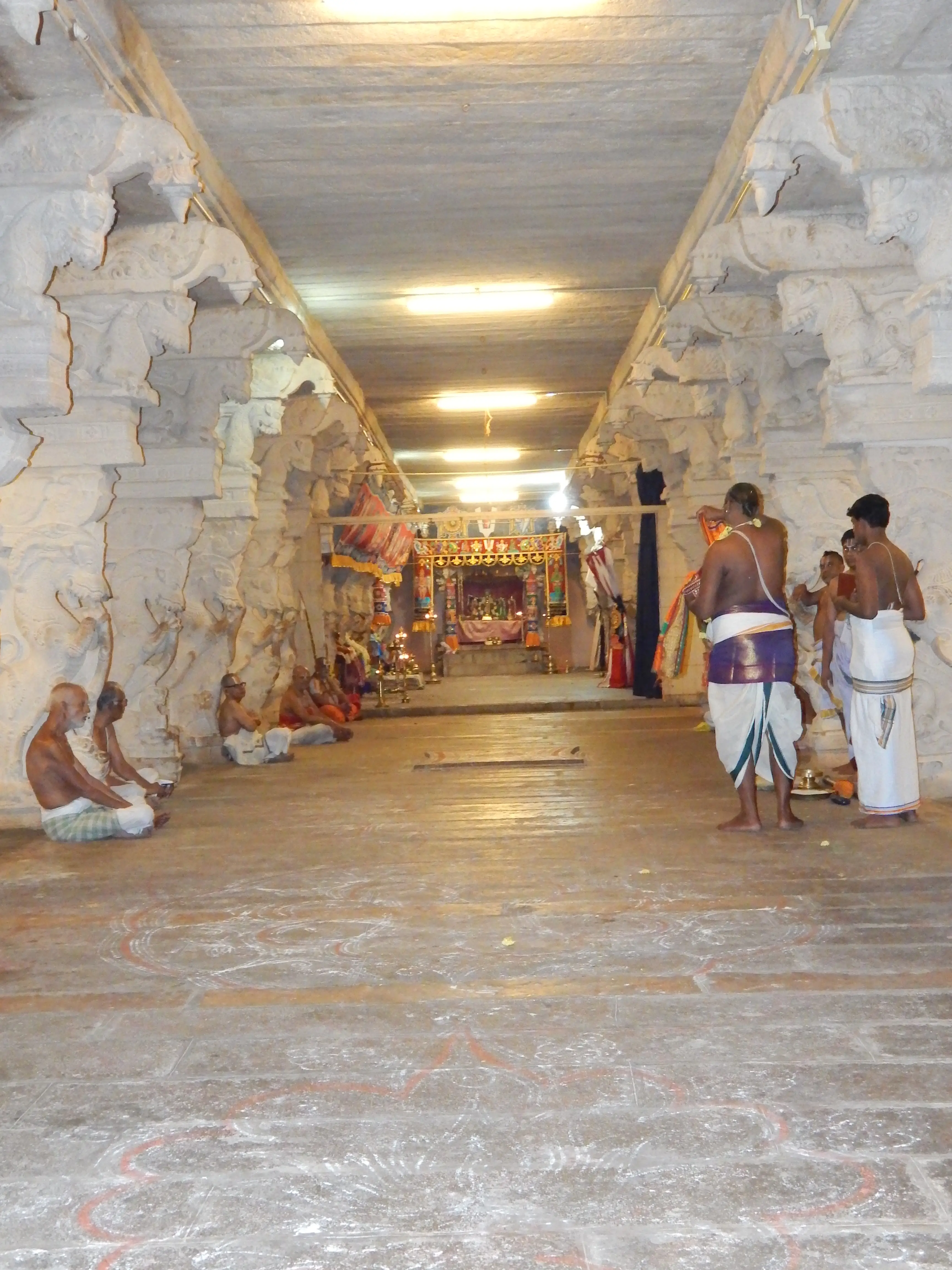
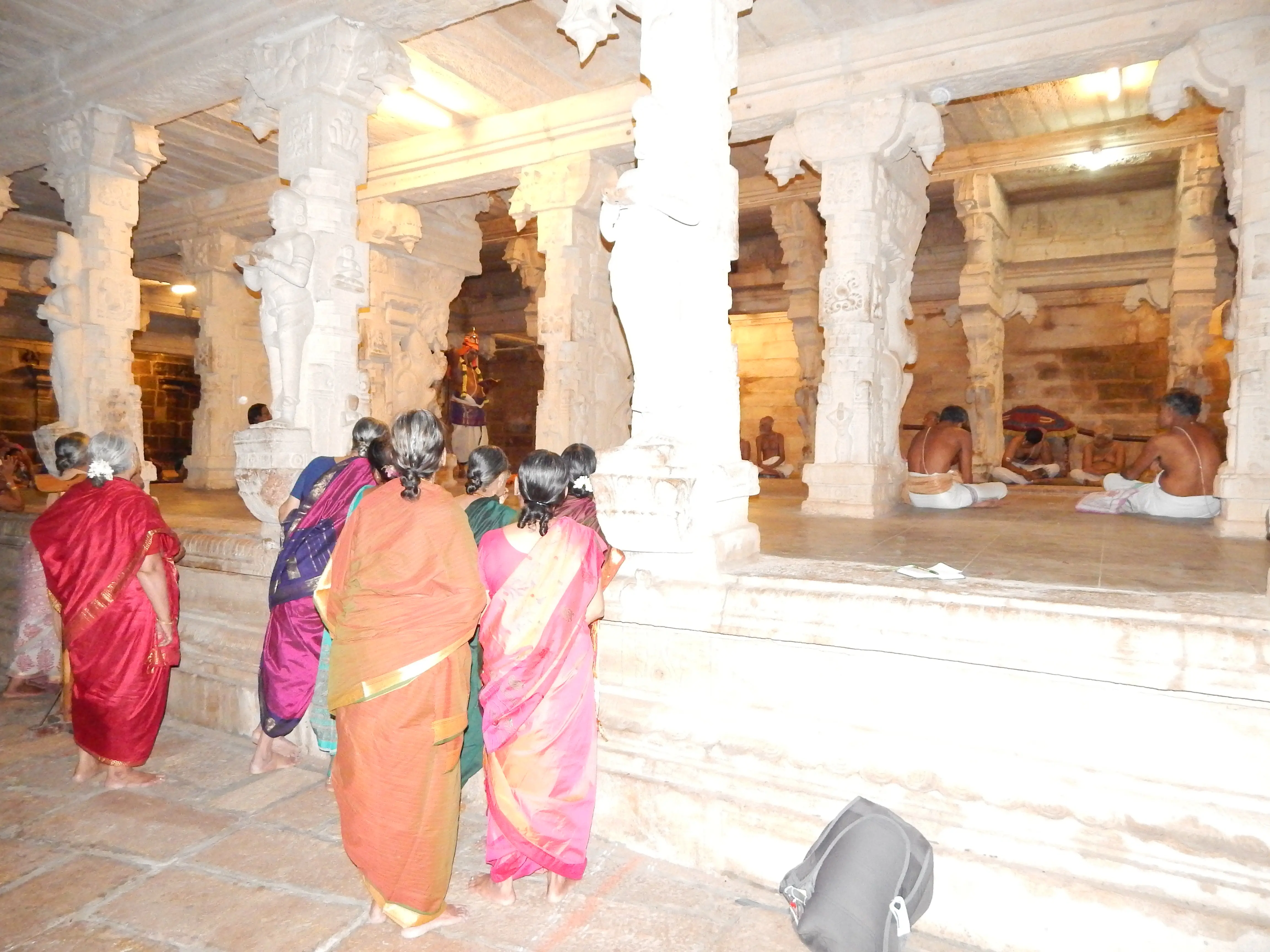
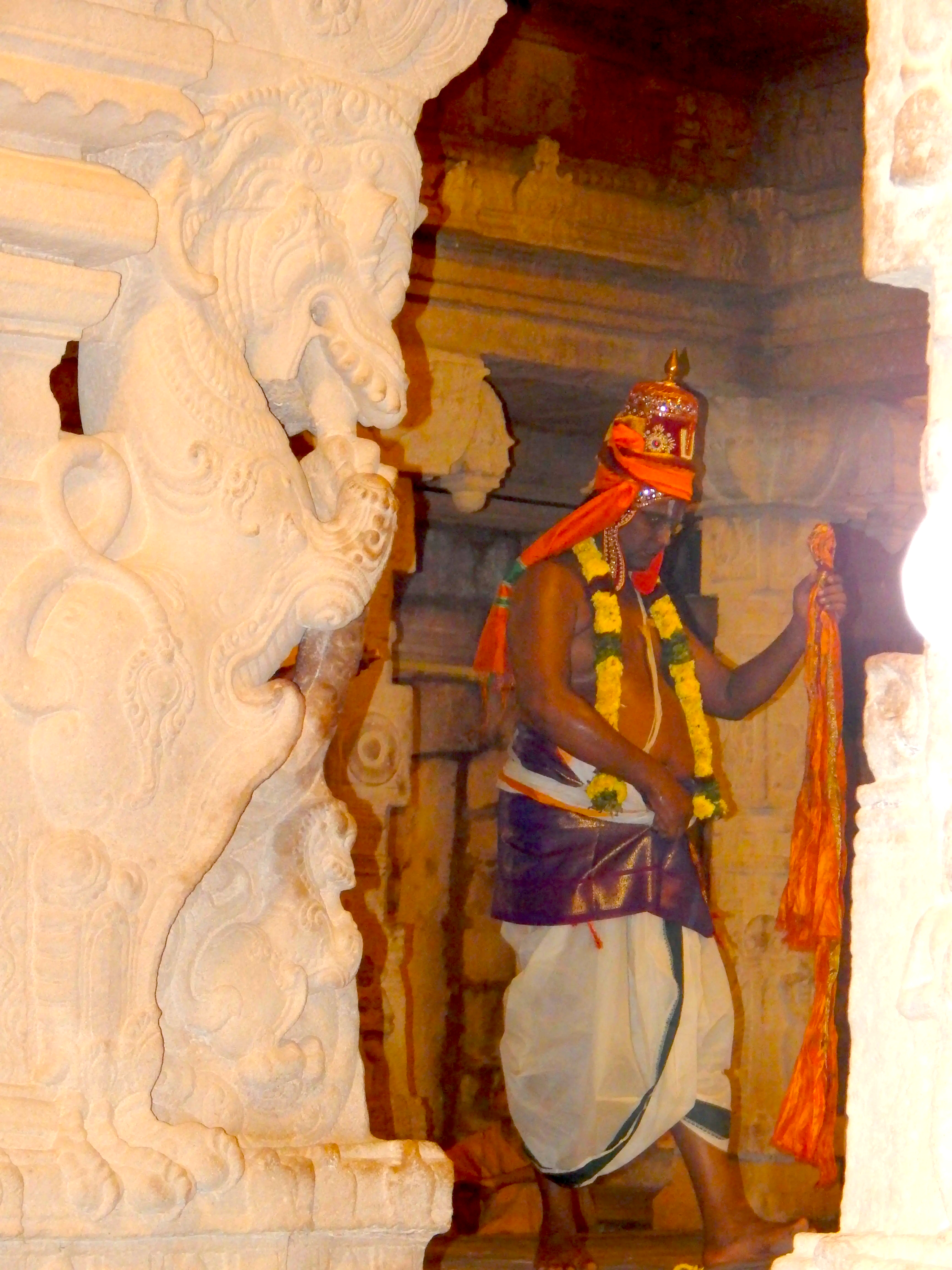
It was late in the afternoon one Mārkaḻi that I encountered an āḻvār poem in a completely new way.7 More precisely, the song, the pācuram, has long been sung this way, and I had heard it sung in exactly this manner, many, many times before. But that afternoon, clustered with all the other women, leaning against the cool stone of the temple pillars, peering up into the muted afternoon shade at the Brahmin men arranged in neat rows [Fig. 1], with Viṣṇu and his darbar obscured from my view, placed at some remove, spatially and visually from the events unfolding above me, all that was left to me was to be attuned to that which I could hear [Fig. 2]. It was the afternoon of the Muttukkuṟi, or Divination with Pearls, a short drama that is performed by the Araiyar, a Śrīvaiṣṇava hereditary ritual specialist, on the ninth day of the pakal pattu (morning ten) of the annual adhyayanōtsavam or Festival of Recitation, a festival celebrated in Mārkaḻi in many Śrīvaiṣṇava temples across the globe.8 At the center of the Muttukkuṟi is a verse from Tirumaṅkai Āḻvār’s Tiruneṭuntāṇṭakam (The Longer Tāṇṭakam):9
-
7This encounter occurred during fieldwork on December 20, 2015, at the Ādi Nātha temple, Alvar Tirunagari. Mārkaḻi falls between mid-December and mid-January.
-
8The Araiyar (reciter) is a male, brahmin Śrīvaiṣṇava hereditary ritual specialist. Their special service (Cēvai) combines recitation and gestural interpretation. The full Araiyar Cēvai survives in three temples in Tamil Nadu: Srirangam, Srivilliputtur, and Alvar Tirunagari. It survives in an abbreviated form at the temple in Melkote. The Araiyars trace their lineage to Nāthamuni (c. tenth century), who is the Śrīvaiṣṇava traditions’ first preceptor. According to Śrīvaiṣṇava oral histories and written hagiographies, Nāthamuni was responsible for compiling and canonizing the Śrīvaiṣṇava Tamil canon, the Nālāyira Divya Prabandham. For a comprehensive discussion of the dating and narratives relating to Nāthamuni and the formation of the Nālāyira Divya Prabandham see Young 2024.
While the Adhyayanōtsavam is celebrated in many Śrīvaiṣṇava temples, only the temples of Srirangam, Srivilliputtur, and Alvar Tirunagari integrate Araiyar Cēvai into the ritual events.
The Adhyayanōtsavam is divided into two halves. The first half, called Pakal Pattu (Morning Ten) is devoted to the recitation of the first two books of the Nālāyira Divya Prabandham, concluding with the liberation (mōkṣa) of Tirumaṅkai Āḻvār. The second half of the festival, called Irā Pattu, begins on Vaikuṇṭha Ēkādaśī and is focused on the recitation of Nammāḻvār’s Tiruvāymoḻi. The Iyaṟpā section of the Divya Prabandham is also recited during this time, generally during processions. Irā Pattu concludes with Nammāḻvār’s mōkṣa.
-
9The Muttukkuṟi also utilizes verses from the Fourth Decad of Kōtai-Āṇṭāḷ’s Nācciyār Tirumoḻi for the actual divination. Such stitching together of the voices of āḻvār poets is typical in commentary and in Araiyar Cēvai performance. It presents a view of the āḻvār text (and by extension, the āḻvār) as inter-penetrating, interlocking, and inter-mirroring. That is, the experiences of the poets are not seen as singular or bounded, but one that is permeable and that permeates the poems, which are the records of the experience. For a discussion of the Muttukkuṟi drama at the Āṇṭāḷ temple in Srivilliputtur see Venkatesan 2005.
The tāṇṭakam is a meter. Tirumaṅkai composed two poems in this meter. The short, 20-verse Tirukkuṟuntāṇṭakam (Shorter Tāṇṭakam) and the longer, 30-verse Tiruneṭuntāṇṭakam. For a discussion of the tāṇṭakam meter and Tirumaṅkai’s use of it, see Ate 2019, 12–23.
paṭṭu uṭukkum ayarttu iraṅkum pāvai pēṇāḷ paṉi neṭuṅ kaṇ nīr tattumpa-p-paḷḷi koḷḷāḷeṉ tuṇai-p-pōtu eṉ kuṭaṅkāl irukkakillāḷ em perumāṉ tiruvaraṅkam eṅkē eṉṟummaṭṭu vikki maṇi vaṇtu muralum kūntal maṭa māṉai itu ceytār tammai meyyēkaṭṭuvicci col eṉṉa-c-coṉṉāḷ naṅkāy kaṭal vaṇṇaṉar itu ceytār kāppār ārēTiruneṭuntāṇṭakam 11
In this verse, the eleventh of the thirty-verse Tiruneṭuntāṇṭakam, three female voices come together to speculate about love and the locus of that love: a mother who is bewildered by her daughter’s erratic behavior, the daughter who is sick with love, and the fortune-teller, who successfully diagnoses the illness. In this short poem, the eleventh verse is pivotal, signaling the shift from an abstract meditation on Viṣṇu’s greatness (Verses 1–10) to the particular experience of this girl, of her mother and her friend who serve as witness to that experience, and of the fortune-teller who affirms the authenticity of the same. And of course, Viṣṇu although absent, is a silent spectator to the unfolding drama. As I watched the Muttukkuṟi performance, taking detailed notes and trying to photograph the proceedings from a very poor vantage, I heard something that startled me—words repeated, words inserted, the poem rearranged—something I had never thought happened in the recitation of āḻvār poetry. Later in the paper, I will address what I heard that afternoon, how it altered my understanding of the āḻvār poem, and how that encounter influenced how I think about translation. For now, suffice to say that the December afternoon encounter was the genesis for what follows here. But back to the verse now.
There is much that can be said about Tirumaṅkai’s complex, multi-tiered, multi-vocal Tiruneṭunṭāṇṭakam, which is a pair to the twenty-verseTirukkuṟuntāṇṭakam, and its long history of commentary within the Śrīvaiṣṇava sampradāyas attests to the poem’s significance. For example, Parāśara Bhaṭṭar (1122–1174 CE), one of the tradition’s most important teachers, reads the poem as encapsulating the meaning and efficacy of the rahasya-traya (the three secret mantras), while the thirteenth century Periyavāccāṉ Piḷḷai, interprets it as an articulation of the Pāñcarātra conceptualization of deity in five forms—paratva, vyūha, vibhava, arcā and antaryāmin—and as a description of the nature of the soul’s servitude (śēṣatvam) in relation to Viṣṇu.10 In short, the Tiruneṭuntāṇṭakam is regarded by the tradition as encapsulating the entirety of Rāmānuja’s Viśiṣṭādvaita philosophy, which argued for the supremacy of Viṣṇu-Nārāyaṇa and theorized the concept of self-surrender (prapatti) as an efficacious path to liberation.11 Indeed, Parāśara Bhaṭṭar is said to have used the Tiruneṭuntāṇṭakam to defeat an advaita scholar in debate at Melkote; this scholar became Nañjīyar (1113–1208 CE), the first commentator of the Tiruvāymoḻi. When Bhaṭṭar returned to Srirangam after his victory, Viṣṇu-Raṅganātha asked him to repeat the arguments. This event, also called Tiruneṭuntāṇṭakam, occurred on the eve of the Annual Festival of Recitation that legend has was first instituted by Tirumaṅkai. At still other Śrīvaiṣṇava temples, recitation of the Tiruneṭuntāṇṭakam closes the first ten days of the Festival of Recitation, paving the way for Tirumaṅkai’s mōkṣa, for legend has it that in this poem he had achieved a state equal to that of Nammāḻvār, the foremost of the āḻvār poets.12 I offer up these stories, legends, commentaries, theology, ritual, and the performative exegesis of the Muttukkuṟi, to gesture to the thickness of an āḻvār poem, its embedded and in many ways embodied lives. No poem is an island.
-
10The rahasya-traya are three foundational mantras, articulations of faith by Śrīvaiṣṇavas. They affirm the supremacy of Viṣṇu, of the inseparability of Viṣṇu and his consort, and assert that Viṣṇu is the devotee’s sole refuge in the quest for liberation, mōkṣa. They are the mūla/tiru mantra, the dvayam, and the carama ślōka. The mūla/tirumantra: ōṁ namō nārāyaṇāya, “Obeisance to Nārāyaṇa.” The dvayam is: śrīman nārāyaṇāya caraṇau śaraṇaṁ prapadyē/śrīmatē nārāyaṇāya namaḥ (I take refuge at the feet of Śrī and Nārāyaṇa/Obeisance to Śrī and Nārāyaṇa) and the carama ślōka (Bhagavad Gītā 18.66): sarvadharmān parityajya mām ēkaṁ śaraṇam vraja/aham tvā sarvapāpēbhyō mōkṣayiṣyāmi mā śucaḥ (Abandoning all other paths, take refuge with me/I will make you free from all sins. Do not despair.).
“By the first ten [verses of the Tiruneṭuntāṇṭakam], the meaning of the tirumantra is made clear; by the second ten [verses], the meaning of the carama ślōka; by the first ten verses, bhakti is described. By the second ten, prapatti, and by the third ten, the [importance of] mediation (puruṣakāra) is proclaimed.” Translation by Narayanan 1987, 140.
This interpretation is repeated in oral interpretations of the text, as it was to me by Araiyar Vadapathrasayi of Alvar Tirunagari during one of our many conversations. This reading is confined to the poem’s opening ten verses.
The five forms of Viṣṇu are paratva (transcendent), vyūha (emanations), vibhava (avatāra), arcā (icon), antaryāmin (in-dwelling).
Periyavāccāṉ Piḷḷai was the first Śrīvaiṣṇava author to compose individual commentaries on every composition in the Nālāyira Divya Prabandham. This earns him the title, vyākhyāna-cakravartī, king of commentators.
-
11There is a substantial body of scholarship on the Śrīvaiṣṇava concept of prapatti. Two important recent interventions are Raman 2007 and Akepiyapornchai 2026. For an overview of the development of the Śrīvaiṣṇava traditions, including a discussion of how different important teachers within those traditions approached prapatti, see Narayanan 1987. For a discussion of Rāmānuja’s philosophy see Lipner 1986.
-
12The phrase used to describe Tirumaṅkai’s attainment is mayaṟvaṟa mati nalam (the virtuous/good mind that cuts through delusion), which occurs in the opening verse of the Tiruvāymoḻi.
To translate an āḻvār poem then, is to be immersed in their worlds and these lives, which are infused by the core Śrīvaiṣṇava reception of āḻvār poetry as anubhava and commentary as anubhava grantha. Put simply, for Śrīvaiṣṇavas, commentary is an extension of the text, a part of a self-nourishing river of emotion that flows undammed and multi-directionally between god, poet, commentator and reader/listener. In such a formulation, commentary is not simply explanation or even argumentation. Rather it is an immersive, somatic experience of another’s experience, translating through expansive interpretation that experience for others to enjoy. Commentary doesn’t fulfill its goal if it only elucidates. Commentary must elicit in its author and its audiences, profound and deep relish. Thus, commentary doesn’t—indeed cannot—stifle this river of emotion, nor does it channel it; instead, it adds to it, another stream, another dissolving heart pouring into the great, rushing river that is the āḻvār’s own anubhava.13
-
13For instance, here is an excerpt from the commentary on the eleventh verse of the Tiruneṭuntāṇṭakam by the celebrated twentieth-century century Śrīvaiṣṇava commentator, Uttamur Veeraraghavachariar, in which he invokes anubhava. He writes about anubhava in the context of discussing the introduction of the female voice, which occurs in the poem’s eleventh verse: ippaṭi strīyāṉvārkaliṉ pācuraṅkaḷai yaṉupavippavar inta nilaiyai uṇarntu cuvattaltakum ... nām avarkaḷiṉ coṟkaḷai yaṉpavikkum pōtu takkavāṟu nāyakiyiṉ nilaikaḷ pala aṟintu koḷvatām “The ones who enjoy (aṉupavippavar) the verse of those who have become women feel and taste this state. When we enjoy their words, we apprehend the heroine’s state” (Vīrarākavācāriyaṉ 1993, 55–56).
Of the roughly four thousand verses that comprise the Nālāyira Divya Prabandham (The Divine Collection of Four Thousand), poems or verses that feature female voices, like the Tiruneṭuntāṇṭakam, become especially potent sites for the cultivation and experience of anubhava, for both the poet and the commentator. This partly has to do with seeking to understand how and why male poets assume a female persona, attention to defining the particularities of female voice, and the dual architectural design that commentators perceive in such poems. Let us take as an example Nammāḻvār (c. ninth century), who like his later contemporary Tirumaṅkai adopts a range of female voices. The commentarial tradition identifies these decads, akapporuḷ (verses of the interior/verses of love), of which there are three kinds: those spoken by the mother (tāy-pēccu), by the friend (tōḻi-pēccu), and by the heroine (talavi pēccu). Of Nammāḻvār’s four compositions, two—the Tiruviruttam and Tiruvāymoḻi—use female voices extensively.14 I will focus below on the Tiruvāymoḻi, the longer of the two works and the fulcrum-text for Śrīvaiṣṇavas.
-
14For a discussion of the dual architecture of the Tiruviruttam see Venkatesan 2014, 142–156. For a discussion of female voices in the Tiruviruttam, see Venkatesan 2014, 124–133. For a fuller discussion of the female voices in the Tiruvāymoḻi see Venkatesan 2020, 20–27. For a discussion of female voices and Tamil Vaiṣṇava bhakti, see Hardy 1983.
The Tiruvāymoḻi (Sacred Utterance/Sacred Truth) is revered by Śrīvaiṣṇavas as the Tamil Veda for the poet repeatedly claims that god speaks through him.15 Composed in Nammāḻvār’s favored antāti format, where each verse in the composition is sonically linked to both the verse that precedes it and follows it, the poem explores a wide range of themes in relation to the poet’s boundless love for Viṣṇu. Intensely personal and confessional, didactic and prescriptive, philosophical and oblique, equal parts joyous and despairing, the Tiruvāymoḻi is read in the long tradition of Śrīvaiṣṇava commentators as recounting Nammāḻvār’s personal and individual quest for union with Viṣṇu. Of the 1102 interlinked verses that comprise the Tiruvāymoḻi, 270 (27 decads), or more than a quarter, are akapporuḷ, or in the private, interior (akam) mode. Of these, three decads are spoken by the heroine’s friend seven are spoken by her mother, and the remaining seventeen decads are in the voice of the heroine.16 In the Tiruvāymoḻi, the heroine is nameless in keeping with classical Tamil akam poetics and with the notion that the heroine’s quest for Viṣṇu is one that can mirror or become a vessel for anyone who chooses to tread this path.17 Yet, for the medieval commentators on these verses, there is also something particular and unique about Nammāḻvār’s experience as a woman, so much so that she earns a name: Parāṅkuśa Nāyikā. Indeed, this nāyikā is distinctive and distinguished from Parakāla Nāyikā, the female voice of Tirumaṅkai, the other āḻvār poet who gravitated towards the female register.18 Despite making this distinction, the commentators generalize and universalize in another direction: asserting that all his female voices/personalities within his compositions are those of Nammāḻvār, with each providing a different vantage into the experience (anubhava) of god.
-
15For example, see this beautiful verse from the end of the Tiruvāymoḻi:
tāṉē āki niṟantu ellāulakum uyirum tāṉē āytāṉē yāṉ eṉpāṉ ākittaṉṉait tāṉē tutittu eṉakkuttēṉē pālē kaṉṉalē amutē tirumāliruñcōlaikkōṉē āki niṉṟoḻintāneṉṉai muṟṟum uyir uṇṭēTiruvāymoḻi X.7.2
He filled me with himself, filled everything every world every life. He became me, called himself me to sing of himself. The king of Tirumāliruñcōlai, sweet as honey milk sugar nectar has devoured me entirely. Venkatesan 2020, 320
-
16As the Heroine's friend: Tiruvāymoḻi IV.6, VI.5 and VIII.9; as the Heroine's mother: Tiruvāymoḻi II.4, IV.2, IV.4, V.6, VI.6, VI.7, and VII.2; as the Heroine herself: Tiruvāymoḻi I.4, II.1, IV.8, V.3, V.4, V.5, V.9, VI.1, VI.2, VI.8, VII.3, VII.7, VIII.2, IX.5, IX.7, IX.9, X.3. The last two decads—IX.9 and X.3—are in the voice(s) of the gōpīs. These are the only two decads in which Nammāḻvār particularizes the voice. In the other heroine-voiced verses, she is anonymous and generic.
-
17Classical Tamil poetry (first to third century CE) was divided into two large, complementary categories. One category was akam, which explored the private sphere, specifically love. Here, the characters in the poem were anonymous stock characters—the hero, the heroine, the mother, the friend, and so forth. The second category was puṟam, which explored the public sphere, and thus concerned kings, poets, war, and ethics. Here, poets named themselves and their patrons. Tamil bhakti poetry draws from both akam and puṟam, inaugurating a new genre. For a discussion of the transformation of classical Tamil poetics into the poetics of bhakti, see Cutler 1987 and Cutler and Ramanujan 1999. For a translation of classical Tamil love poems, see Ramanujan 1967 and Selby 2000 and 2011. For a discussion of the transformation of classical Tamil poetics to Tamil bhakti poetics, see Cutler 1987 and Cutler and Ramanujan 1999.
-
18Several of the āḻvār poets use the female voice. This female voice maybe generic and anonymous voice, particular and identifiable, or particular but anonymous. For example, Viṣṇucittaṉ-Periyāḻvār uses a particular and identifiable female voice (Yaśodā) as does Kulaśēkhara (Devakī, Kausalyā). Kulaśēkhara and Kōtai-Āṇṭāl use a particular but anonymous voice, the gōpī. Several of the āḻvār poets use a generic, anonymous female voice, which in the commentaries comes to be identified with the poet themselves. For a discussion of the particularity of female voices, see Venkatesan forthcoming and Kannan 2026.
The akapporuḷ verses uttered by a range of female characters—the heroine, friend, mothers—overwhelmingly describe love in separation, and on occasion even unrequited love. This is one of the reasons that Hardy characterized the poetry of the āḻvār, particularly that of Nammāḻvār, as viraha bhakti, a bhakti whose primary mode of expression is through love in separation. The Śrīvaiṣṇava tradition approaches these verses from a slightly different angle, even as they acknowledge that ‘separation’ is a motif of some significance. For the commentators, female-voiced āḻvār verses operate on two levels—an external meaning known as anyāpadēśārtha and an inner meaning referred to as svāpadēśārtha. Anyāpadēśa reads the poem as just a love poem, while svāpadēśa, reveals how the love poem points to something greater, something beyond itself. The commentators develop a complex typology of interpretation that carefully maps the relationship between these intertwined levels of meaning, what I’ve referred to as the poem’s dual architecture.19 In fact, so important is this interpretive technique that an entire work called the Ācārya Hr̥dayam (The Teacher’s Heart) is composed in the thirteenth century to systematize this reading practice. Some examples from the Ācārya Hr̥dayam that provide these guidelines in pithy statements: a description of a woman’s bright, broad forehead, a mark of beauty denotes an expansion of knowledge; the beautiful curve of her brow (compared to a bow) refers to the control of the karaṇas; her red lips refer her to her great passion (rāga) to attain Viṣṇu; a messenger, such as the haṁsa, is the ācārya; a white crane signifies inner purity, and the cloud those people who are forever immersed in Viṣṇu.20 And finally, the three female voices of the Tiruvāymoḻi are argued to represent the three parts of the Tirumantra: Ōṁ Namō Nārāyanāya, the first of the rahasya traya, which our introductory poem, Tiruneṭuntāṇṭakam is said to encapsulate. The companion (tōḻi) is Ōṁ, which enables the soul (heroine) to attain Viṣṇu; the mother is the means, the upāya, the one who regulates the girl’s rowdy desire, cautioning her that she must wait for her groom to come for her, hence the mother is Namō, the mantra’s second syllable. The girl represents the state that forgets that Viṣṇu controls all things because he is both the way (upāya) and the goal (upēya). She thus represents the final syllables of the Tiru Mantra: Nārāyaṇa.21 Finally, these poems in the female voice describe the fundamental relationship between god and devotee, her pāratantryam (dependence) and his svātantryam (independence). Let us look at a verse from Nammāḻvār’s Tiruviruttam to see how a commentator handles the poem’s dual architecture. The Tiruviruttam is particularly suited to illustrating this mode of double reading to mimic what the commentator’s identify as the poem’s double structure—its inner meaning (svāpadēśa) and its outer meaning (anyāpadēśa)—for it is premised on recounting the unfolding relationship between a nameless hero and heroine.
-
19For a detailed discussion of this dual architecture as it pertains to a single work, see Venkatesan 2014, 142–156.
-
20Damodaran 1976, 70–77.
-
21Damodaran 1976, 64–65.
The Tiruviruttam is considered by the Śrīvaiṣṇava tradition to be Nammāḻvār’s first composition. It begins with the poet asking Viṣṇu to appear before him in an embodied form (meyn niṉṟu) to listen to his viṇṇappam, his petition (Tiruviruttam 1).22 From there it shifts and recounts a love story between the heroine and hero. Although there is no explicit suggestion within the poem itself, the Śrīvaiṣṇava commentators read the young woman as Nammāḻvār’s female alter ego, the Parāṅkuśa Nāyikā. This then, is the first move towards allegoresis and towards developing the inner, svāpadēśa.23 To better illustrate the Śrīvaiṣṇava commentator’s project of developing these two intertwined meanings, here is the second verse from the Tiruviruttam, first in Tamil and then in translation, followed by a summary of the commentary by Periyavāccāṉ Piḷḷai, who authored the first, extant commentary on this work.
-
22poyniṉṟa ñāṉamum pollā oḻukkum aḻukku uṭampumin niṉṟa nīrmai iṉi yām uṟavāmai uyir aḷippāṉen niṉṟa yōṉiyumāyp piṟantāy imaiyōr talaivāmeyn niṉṟu keṭṭarulāy aṭiyēṉ ceyyum viṇṇappamēTiruviruttam 1
False wisdom wicked conduct dirty bodies Let’s not draw near such things now To protect life you took birth from many wombs O master of the unblinking one stand before me embodied listen graciously to a servant’s plea. Venkatesan 2014, 25
-
23For an excellent discussion of allegoresis and Śrīvaiṣṇava commentary, albeit in relation to the Vālmīki Rāmāyaṇa, see Rao 2015.
ceḻu nīrt taṭattuk kayal miḷirntāl oppa cēyarik kaṇaḻu nīr tuḷumpa alamarukiṉṟaṉa vāḻiyarōmuḻu nīr mukil vaṇṇaṉ kaṇṇaṉ viṇ nāṭṭavar mūtuvar āmtoḻu nīr iṇai aṭikkē aṉpu cūṭṭiya cūḻ kuḻaṟkēTiruviruttam 2
Her eyes with fine, red lines dart
like kayal in a full pond,
let her live, the girl with thick, curly hair.
Her love adorns the feet of Kaṇṇaṉ,
dark as laden storm clouds—
Him worshipped by the ancient ones
who live in the sky.24
-
24This is a new translation of the verse for the purposes of the paper. I have left out the colophon identifying the speaker, which is borrowed into the translation from the commentary. The published translation creatively uses spacing and indenting to reveal the poem’s structure. See Venkatesan 2014 for a complete translation of the Tiruviruttam.
The Tiruviruttam does not identify the speaker of the verse, in keeping with the practice of Caṅkam Tamil love poetry, where only later colophons and even later commentaries intervene to suggest the identities of the speakers. Periyavāccāṉ Piḷḷai is attentive to this legacy, even if he does not call it out explicitly. So, his first step in generating the anyāpadēśa or outer meaning, is to identify the speaker of the verse as the tōḻi, the heroine’s friend. From there, he gives us the interpretation: After the heroine (talavi) and the hero (talaivaṉ) have seen each other, they experience separation. This verse occurs during that time and the friend (tōḻi), who is responsible for uniting the two lovers, marvels at their great love and wishes that their great love lives on.25 Note that in his commentary, Periyavāccāṉ Piḷḷai does not identify the heroine with Nammāḻvār. He simply reads the verse as recounting a moment in a grand love story between two human lovers. There is no hint in this interpretation that the Tiruviruttam is a religious poem, composed by a poet devoted to Viṣṇu. All that comes into full bloom when Periyavāccāṉ Piḷḷai develops the svāpadeśa. In brief, this is what he says: the āḻvār is constantly experiencing Viṣṇu, but he disappears, and the āḻvār is overcome by terrible suffering. This causes him to forget his nature, and so he begins to imagine himself as the goddess (pirāṭṭi). In this state, her eyes dart like fish because she (he) is searching for Viṣṇu. The people watching are his disciples (bhāgavatas) or other devotees (bhaktas), who are astonished by the āḻvār’s experience that they praise his love. They are the tōḻi, who wish that her husband (nāyakaṉ) returns to her quickly to enjoy the beauty of her eyes that are like fish darting in a full pond. And thus, may her suffering end. While the outer meaning skims the surface of the verse, the svāpadeśa digs deeper, seeking to access the anubhava that triggered such a moving and profound verse. In doing so, nearly every actor in the verse gestures to something outside of the verse itself—the heroine is not just Nammāḻvār’s female alter ego, but the goddess Śrī herself. By extension, then this means that the heroine (i.e., the poet) and Viṣṇu are as inseparable as Viṣṇu and his beloved consort. The friend is Nammāḻvār’s own devotees or his disciples. The only figure who remains stable in this verse—that is there is no difference in the anyāpadēśa and svāpadēśa interpretations, is Kaṇṇaṉ, the god whom the girl adorns with her love.
-
25Tiruviruttam, pp. 29–38.
Even this brief glimpse into the Śrīvaiṣṇava commentator’s art gestures to the challenges of a translator working with a text like the Tiruviruttam, the longer and more complex Tiruvāymoḻi, or indeed any of these girl-songs in the āḻvār corpus. These texts are inextricably intertwined with their commentaries, such that one might say they are almost contiguous. The translator could well reject or bracket the commentator’s interventions, approaching the poem on her own terms. Alternatively, the translator could rely minimally on the commentary for glosses of difficult words or discussion of points of grammar. Most translators, and I include myself in this number, have chosen the latter option. In this paper, I suggest an integrative, perhaps more radical, path, where the translator thinks alongside commentary and the deep embeddedness of these poems within the ritual, emotional, affective, and religious lives of Śrīvaiṣṇavas.
Translation as Relish
In the second half of the essay, I turn to the pragmatic and practical aspects of translating with relish, translating as though one is a Śrīvaiṣṇava commentator, feeling the āḻvārs’ words fully and immersively. I think of this translation not just as relish and enjoyment, but as a translation of the inside, from the inside, and one guided by Śrīvaiṣṇava formulations of anubhava and of commentary as anubhava grantha. Commentary is not meant simply to elucidate and decode; rather it is meant to induce, mimic, and replicate divine savoring. In other words, commentary too, is guided by aesthetic concerns and seeks to produce an aesthetic affect. Within this paradigm, Śrīvaiṣṇava commentary is conceived of as an anubhava grantha, a text of experience, a term that understands experience (expressed as anubhava) as central to their theological project. Conceptualized as such, a proper commentary succeeds only when it acts as an effective and affective conduit between the āḻvār’s savoring of god and the reader/listener. Just as the āḻvār is a vessel filled to brimming with god’s presence, to produce a flavorful commentary the āḻvār’s experience must inhabit the commentator. Such exegesis becomes a delicately balanced, multi-tiered edifice of enjoyment, recording both the mutual relish of Viṣṇu and an āḻvār’s savoring of god and the commentator’s own savoring of both. The commentaries rarely are word-for-word explications of the text; rather, they are an interpretation of the verse as a unit, placed first within the content of the mini world of the decad, and then within the macro-narrative of the text as a whole, say the Tiruvāymoḻi. This is how anubhava is nurtured and built, as the commentator seeks to get into the skin of the poem, and in so doing, enters the skin of the poet. Phrased differently, this is commentary from the inside, a commentary both of interiority and on interiority. This is also the task of the translator—to burrow into the heart of a text and to speak outwards from within it. The act of translation is anubhava and the text it produces is equally an anubhava grantha, a text of enjoyment, of experience, yet another conduit through which anubhava flows from god to āḻvār to devotee, and so on in an unbroken link. This dynamic anubhava is possible because both the āḻvār(s) and their texts are seen as permeable. The āḻvār is permeable to god’s presence and god is permeable to the āḻvār. It is such permeability that in the telling of the āḻvār brings forth the poem as in this remarkable example, where Nammāḻvār warns other poets that their voices, bodies, poems may not be their own:
ceñcol kavikāḷ uyir kāttu āṭceymmiṉ tirumāliruñcōḷaivañcak kaḷvaṉ mā māyaṉ māyak kaliyāy vantu eṉneñcum uyirum uḷ kalantu niṉṟār aṟiyāvaṇṇam eṉneñcum uyirum avai uṇṭu tāṉē āki niṟaintāṉēTiruvāymoḻi X.7.1
Poets of fine words, take care. The cunning thief
the great trickster of Tirumāliruñcōlai
stole into my heart and into my life, a magical poet
he dissolved into me, remained there unknown
devoured my heart and my life
then filled me with himself.Venkatesan 2020, 320
The effective commentator must also make himself open to the āḻvār, and it is such openness that enables openness to god’s presence. Similarly, in this framework, the text itself is understood to be porous, for it is the site of anubhava. It is porous to the commentary, it is porous to other āḻvār poems, and most importantly, it is porous within itself—I will say more about this final assertion below. Thus, if the text and its author are permeable, fluid, and dynamic like water, then the notion of a fixed and stable translatable text evaporates. In other words, bracketing out commentary and the thick embeddedness of the āḻvār poem creates an artificially fixed text, one that may not be conducive to the cultivation of anubhava. Instead, if our starting point is the fundamental and interactive dynamism of our source-poem, it allows us to move beyond the debate within Translation Studies of sense and sensibility, of whether a translation is faithful or not, and between the literal and the literary. That is, if we free ourselves from thinking of a text as having a fixed, singular form, then we equally free ourselves from producing a translation with a single, fixed form. Translation is no longer thought of in negative terms—as a wound to the text, a betrayal, or a loss. It gives us permission to consider translation as pleasure, as liberating, as a process of relish that in turn births a text of relish.
I now offer two verses and three approaches of how I envision a translation of relish, a translation practice rooted in anubhava. The experiments I offer below are not comprehensive or exhaustive. Instead, they are suggestive and invite the reader to experiment with the text themselves, to remake them into their own anubhava granthas. In my experiments below, I have taken cues from the commentators and attempted to integrate their interpretations, their anubhavas, into the translation. I have also been guided by my long years of fieldwork in several Vaiṣṇava temples in the southern Tamil regions, witnessing temple rituals, listening to recitations and spontaneous expositions, marveling at the tears that spring from a devotee’s eyes as she contemplates a line of verse or the thrall in which she finds herself when in Viṣṇu’s presence. In producing these anubhava granthas, I have sought to be open and fluid, to be receptive to all the ways in which these poems are inhabited and inhabit the world. In producing these translations, I have disciplined myself into a body primed for anubhava—to make my body be permeable to feeling, to let the tears come when reading a verse; to make myself empty so that the words of poet and commentator may echo within; to become porous, so feeling might pour out through my pores as translation. Another translator, another reader will make different choices and will choose a different direction in which to take the translation. And, ultimately, as I hope to show, that is the point.
With these caveats and this preamble, we move to the translations of the two verses I have chosen for this experiment. The first example is the opening verse from the Seventh Hundred [VII.2.1] of Nammāḻvār’s magnificent Tiruvāymoḻi, while the second is the eleventh verse from the Tiruneṭuntāṇṭakam by Tirumaṅkai, which I introduced at the start of this paper. I have chosen these two verses because of their importance in the Annual Festival of Recitation, and because they both praise the first among temples, Srirangam (Tiruvaraṅkam in Tamil).
The First Anubhava: Tiruvāymoḻi VII.2.1
To begin: something about the second decad of the Tiruvāymoḻi’s Seventh Hundred, its Ēḻām Pattu [VII.2]. These ten verses are spoken by the heroine’s mother, and it is the last set in the Tiruvāymoḻi rendered in her voice. However, in the commentaries, VII.2 is contextualized not in terms of the decad that immediately precedes it—VII.1—but the set of ten verses that conclude the previous centum [VI.10]. VI.10 is considered central to the Tiruvāymoḻi, for it is in these verses that Nammāḻvār is portrayed as seeking refuge with the lord of Tiruvēṅkaṭam, in the act of prapatti, the paradigmatic act of surrender, encapsulated in the penultimate verse of the decad in which he says:26
akala kilēṉ iṟaiyum eṉṟu alar mēl maṅkai uṟaiyum malarmārpānikaril pukaḻāy ulakamūṉṟu uṭaiyāy eṉṉai āḻvāṉēnikaril amara muṉikaṇaṅkaḷ virumpum tiruvēṅkaṭaṭāṉēpukal oṉṟillā aṭiyēṉ uṉ aṭikkīḻ amarntu pukuntēṉēTiruvāymoḻi VI.10.10
‘I won’t part from you for an instant’
says Śrī who rests on your chest,
lord of matchless fame,
holder of the three worlds,
my king, master of Vēṅkaṭam
dear to peerless immortals and sages
with nowhere else to go, I’ve settled at your feet.Venkatesan 2020, 215
The starting point for the commentary on VII.2 is this: how is it that the āḻvār who surrendered to Viṣṇu at Tiruvēṅkaṭam has now been brought to a point of despair because of separation?27 The intermediary section, VII.1, is a philosophical mediation on the nature of the senses and how it binds one to the world. The commentator, Nampiḷḷai, notes that once Nammāḻvār is persuaded to put off mōkṣa and instead simply performs prapatti, he finds himself in this world, subject to the senses, in the snare of the world, in prakr̥ti, or prakr̥ti-sambandham (relationship with the world and matter). Like Sītā, a prisoner in Rāvaṇa’s Aśōka grove, cries out to be rescued by Rāma, so too does the āḻvār desire such intervention.28 This then in broad strokes, is the context that the commentator provides to lead into Tiruvāymoḻi VII.2. It is significant that both decads—VI.10 and VII.2—are addressed to the two of the most important sacred sites for Tamil Vaiṣṇavism: Tiruvēṅkaṭam, modern day Tirupati, and Tiruvaraṅkam/Srirangam. It is worth noting here that VII.2 is also the only set of verses in the entire Tiruvāymoḻi dedicated to Srirangam, the site that is revered as the Bhūloka Vaikuṇṭha, or heaven on earth. At Srirangam, where the Annual Festival of Recitation is celebrated with great pomp during the month of Mārkaḻi, Nammāḻvār is dressed as the Parāṅkuśa Nāyikā, his female alter ego, on the night dedicated to the Tiruvāymoḻi’s Seventh Hundred.29 As Vasudha Narayanan observes (1994b, 173), in addition to the recitation of the cycle of 100 verses from VII.1 to VII.10, the Araiyars and assembled Brahmin men, recite poems not in honor Viṣṇu but those praising Śrī. One way to read the choice of recitation is to regard within the context of the role of the goddess as a mediator, one who can intercede on behalf of the poet. It might also be said that the girl seems to be goddess-like (pirāṭṭi taṉmai, the nature of the goddess), wanting a union and state of being that forever is in union with Viṣṇu, a quality unique to Śrī. The thirteenth century Maṇipravāḷa Ācārya Hr̥dayam (The Heart of the Teacher), a work devoted entirely to the Tiruvāymoḻi, offers the most concise distillation of the place of female-voiced songs in Nammāḻvār’s most important work.30 In Cūrṇikai 118, Aḻakiya Maṇavāḷa Perumāḷ Nāyaṉār, the text’s author states jñanattil tam pēccu/prēmattil peṇ pēccu—“In wisdom/knowledge it’s his voice, and in love, it is a woman’s voice.”31 Here knowledge (jñāna) is indexed as union (saṁślēṣa) and love (prēma) is separation (viślēṣa). But what it is important to remember that love is articulated as such, because the desire is for an intense, somatic enjoyment of god—to see him with physical eyes, to have him enter your physical body, to embrace his corporeal form. And such an interpretation is not without support in the Tiruvāymoḻi: in the saṁślēṣa decad of VI.10, spoken purportedly in the āḻvār’s own voice and the viślēṣa decad of VII.2 spoken in a female voice (that of the mother).32 As the Ācārya Hr̥dayam makes clear, in the end there is no difference between these two registers, both being natural to Nammāḻvār, what is spoken as the aṭiyōm (male servant) simply becomes that which is said by the aṭicci (a female servant): aṭiyōm toṭarntu kuṟṟēval / aṭicciyōm aṭikkīḻ kuṟṟēval (Ācārya Hr̥dayam 120).33 As an aside: when commenting on this decad, the great ācārya, Parāśara Bhaṭṭar (1122–1174), would press his palms to his forehead, overcome by emotion, by the anubhava of the verse, and fret at our inability to do justice to the nāyikā’s abiding, all-consuming, immersive love for Viṣṇu. His despair is akin to the heroine’s, who tries in vain to catch her cascading tears in her cupped hands. The dissolving self that breaches the body cannot be contained by two small hands, just as the ocean cannot be emptied with a leaf. And so too is it for Parāśara Bhaṭṭar, who presses his palms to his head as though to contain all that unruly, ungovernable, leaking, leaching experience.
-
27There are several commentaries on the Tiruvāymoḻi. Here, I am relying on the commentary called the Īṭu. The text’s rich and continuous commentarial history stands in stark contrast to the paucity of available translations of the Tiruvāymoḻi. The earliest commentary was written by Tirukkurukai Pirāṉ Piḷḷāṉ (eleventh to early twelfth century) at the behest of Rāmānuja (1017–1137). This is referred to as the Ārāyirappaṭi (6000). This is followed by Nañjīyar’s 9000 (twelfth century), his student Nampiḷḷai’s magnum opus 36,000 paṭi composed also known simply as the Īṭu, and the 24,000 paṭi commentary by Vyākhyāna Cakravarti, Periyavāccāṉ Piḷḷai, who was Nampiḷḷai’s student. In addition to these classical commentaries, which were largely composed between the eleventh and fourteenth centuries, there are innumerable twentieth-century exegeses of the text, with two towering figures representing them: Uttamur Viraraghavachariar, whose interpretations represent the Vaṭakalai or northern branch of the Śrīvaiṣṇava Sampradāya, and Anangachariar Svami of the Teṅkalai school. Vēdānta Dēśika (1268–1369) composed a Sanskrit commentary/summary of the Tiruvāymoḻi called the Drāmiḍōpaniṣad Tātparya Ratnāvalī (The Garland of Gems of Reality in the Tamil Upaniṣad). Apart from Dēśika’s important work, all the classical commentaries on the Tiruvāymoḻi are composed in Maṇipravāḷa, a stylized hybrid language that combines Sanskrit vocabulary with Tamil grammar. As several scholars have pointed out, the choice to author commentaries in Maṇipravāḷa rather than Tamil or Sanskrit is itself a statement of Śrīvaiṣṇavism’s self-representation as Ubhaya Vēdānta (Dual Vēdānta). It is also worth noting that the classical commentaries predate the sectarian split of the Śrīvaiṣṇava Sampradāya into the Vaṭakalai and Teṅkalai schools. In addition to these commentaries, we have an additional work, the Ācārya Hr̥dayam, authored by the thirteenth century teacher, Aḻakiya Maṇavāḷa Perumāḷ Nāyaṉār (see below). For a thorough discussion of Piḷḷāṉ’s commentary, see Carman and Narayanan 1989.
-
28The Śrīvaiṣṇava commentators often resort to invoking the Vālmīki Rāmāyaṇa in their commentaries. In this epic poem, the hero, Prince Rāma, is exiled to the forest for a period of twelve years. He is accompanied by his chaste wife, Sītā, and his devoted younger brother, Lakṣmaṇa. Towards the end of their exile, Sītā is abducted by the demon-king, Rāvāṇa, and imprisoned in his fortressed-island city of Laṅkā. Rāma wages a war against Rāvaṇa, killing him in battle, and rescuing his wife. He returns home with his wife and brother, and is crowned king, ushering a utopic period of peace and abundance. Rāma is an avatāra of Viṣṇu and Sītā is the goddess, Lakṣmī. In the commentarial readings, Sītā is the soul/self, yearning for union with god (Rāma). For a fulsome discussion of the use of the Rāmāyaṇa in Śrīvaiṣṇava commentary, see Narayanan 1994a.
-
29This unfolds on the seventeenth night of the Adhyayanōtsavam and the seventh night of the Irā Pattu Utsavam/Tiruvāymoḻi Utsavam.
-
30Composed by Aḻakiyamaṇavāḷa Perumāḷ Nāyaṉār, a scion of the famous Vaṭakkuttiruvīti Piḷḷai, author of the authoritative Īṭu commentary on the Tiruvāymoḻi, the Ācārya Hr̥dayam offers a succinct contemplation of Nammāḻvār’s poetry and its philosophy in 234 sūtras (referred to as cūrṇikai).
-
31Ācārya Hr̥dayam, pp. 93–95.
-
32Here are two exemplary verses from these two decads that support the commentators’ indexing of the āḻvār’s voice in terms of union and separation. In VI.10, he is experiencing union/or union is imminent and thus speaks in his own voice:
vantāy pōlē vārātāy vārātāy pōl varuvāṉēcentāmaraik kaṇ ceṅkaṉi vāy nāltōḷ amutē eṉatu uyirēcintāmaṇikaḷ pakar allaip pakal cey tiruvēṅkaṭatāṉēantō aṭiyēṉ uṉ pātam akalilēṉ iṟaiyumēTiruvāymoḻi VI.10.9
You seem to come, then don’t you seem not to come, yet here you are, eyes bright as lotus lips red as fruit four great shoulders, sweet nectar my precious life, master of Tiruvēṅkaṭam where brilliant gems turn night into day I can’t be apart from your feet for an instant. Venkatesan 2020, 215
In contrast, VII.2 is decidedly from the vantage of separation. The āḻvār is separated from Viṣṇu and hence speaks in his female guise. But there is a double separation, as the girl’s mother too is separated from her daughter, who has given herself over to Viṣṇu:
cintikkum ticaikkum tēṟum kai kūppum tiruvaraṅkattuḷḷāy eṉṉumvantikkum āṅkē maḻaikkaṇ nīr malka vantiṭāy eṉṟu eṉṟē mayaṅkumantippōtu avuṇaṉ uṭal iṭantāṉē alai kaṭal kaṭanta ār amutēcantittu uṉ caraṇam cārvaṭe valitta taiyalai maiyal ceytāṉēTiruvāymoḻi VII.2.5
She’s lost in thought, faints, recovers, cups her hands muttering, ‘You’re in Tiruvaraṅkam.’ Come here she calls as her eyes rain tears. As dusk fell you ripped apart the demon precious nectar who churned the ocean You’ve bewitched this girl now wasting away She only desires to be at your feet. Venkatesan 2020, 223
-
33Ācārya Hr̥dayam, pp. 93–95.
There is much that one can say about the beautiful moments of exegesis in the commentary to Tiruvāymoḻi VII.2:34 that women who enjoy their husbands during the night, sleep during the day, while others work during the day and can sleep at night. This girl, ignored by Viṣṇu, doesn’t understand sleep, doesn’t even know what it is. She is like Lakṣmaṇa, who took a vow to stay awake all the years of Rāma’s exile, and this is of course compared to Viṣṇu as Raṅganātha, who is himself ‘asleep’ on his snake-bed in Srirangam. Her tears flow as abundantly as the Kaveri that encircles Srirangam, and like the fish that live in those waters and cannot live outside of it, she too is immersed in Viṣṇu and cannot be apart from him for even a moment. She will not live. In a later verse [VII.2.3] the girl’s staring at the sky is explicated imaginatively—she stares at the sky thinking that Viṣṇu will descend to give her grace like he did for Gajendra. In weeping, with her heavy sighs, and her aimless wandering, she has abandoned her strītvam, her femininity. How can Viṣṇu allow such a state to befall her? Is such rejection or unresponsiveness a mark of his sauśīlya (his amiability/his intimate connection with his devotee)?35 The mother’s despair is cut short, as the decad concludes with the girl finding refuge at the feet of the lord of Tiruvaraṅkam/Srirangam.
-
34Bhagavat Viṣayam, vol. 7, pp. 50–56.
-
35Bhagavat Viṣayam, vol. 7, pp. 56–61.
In offering this short summary of the main commentarial points on this verse specifically and the decad more broadly, culled from a range of commentaries, it becomes clear that the Śrīvaiṣṇava commentators are not necessarily interested in explicating the text in isolation.36 It is set within their broader narrative of the Tiruvāymoḻi (a quest that oscillates between separation and union, but culminates in the final decad in union), and they offer little assistance to the translator who wrestles with trying to make some sense of a particularly difficult verse. So, how does a translator approach a text like the Tiruvāymoḻi? Or phrased another way, how might a translator work to incorporate some of this rich commentarial experience, anubhava, of the text into a translation. The easy way would be to offer lots of footnotes, perhaps a lengthy summary of commentary, a hefty introduction. This has generally been my approach, fragmenting, or more appropriately, compartmentalizing anubhava. None of these options get to the heart of what Śrīvaiṣṇava commentary does, that its imperative is to convey anubhava and to elicit that anubhava in others.
-
36For a discussion of the art of the Śrīvaiṣṇava commentator, see Clooney 1996. For a thoughtful analysis of the commentaries on two girl-voiced decads in the Tiruvāymoḻi, see Clooney 1991 and 1988.
With these ideas in mind, I offer an English translation of the first verse of the seventh decad of the Tiruvāymoḻi, anchored in anubhava, where translation is not ‘other,’ ‘deficient,’ ‘derivative’ or ‘copy,’ but an extension, existing on an ever-refreshed continuum of anubhava granthas, what Benjamin calls the “after life of the text.”37
-
37I propose that Śrīvaiṣṇava commentaries function like translation and a translation as relish, as anubhava, is a commentary. Thus, both the commentary and the translation ensure the afterlife of the text. See Benjamin 2021.
In this spirit, I present first the Tamil text followed by a clip of the verse’s recitation:
kaṅkulum pakalum kaṇ tuyil aṟiyāḷ kaṇṇa nīr kaikaḷāl iṟaikkumcaṅku cakkaraṅkaḷ eṉṟu kai kūppum tāmarai-k-kaṇ eṉṛē taḷarumeṅṅṉē tarikkēṉ uṉṉai viṭṭu eṉṉum iru nilam kai tuḻā irukkumceṅkayal pāy nīr tiruvaraṅkattāy ivaḷ tirattu eṉ ceykiṉrāyē
Here is what I refer to as a straight translation of the same:
Night and day her eyes know no sleep
Tears pool in the palm of her hands
‘Conch’ ‘Disc’ she cries, pressing her hands together
‘Eyes-lotus’ she cries, growing faint
‘How can I live without you?’ she says
searching this vast earth with her hands.
Lord of Tiruvaraṅkam where red fish dart through the water
What have you done to my girl?
And now, I offer this by way of a translation that thinks of itself as an anubhava grantha. It stays sensitive to the dual architecture of anyapadēśa and svāpadēśa. A colophon of sorts introduces the poem, setting it within the context of the broader narrative structure of the Tiruvāymoḻi. To reproduce the feel of the recitation, which relishes and draws attention to the long lines of rolling text, as though to capture all that emotion that flows without end, the translation too is set in long lines with minimal punctuation:
A girl in love found her man in Tiruvēṅkaṭam. He left asked her to return. She wouldn’t give up and she sought him and in seeking him found him in Tiruvaraṅkam.38 Her name is Parāṅkuśa Nāyikā. Her mother found her there, sleepless, staring at the sky, weeping and with no care for modesty or shame. She had gone from knowledge to love. What kind of woman had she become? Her mother in despair took the lord of Tiruvaraṅkam to task and had these words to say:
She won’t close her eyes in sleep, not for a moment not night or day
She can’t close her eyes in sleep. Tears pool in the palm of her hands,
Can you scoop the ocean with your hands, tell me, lord?
‘Conch’ ‘Disc’ she stutters pressing her hands together, ‘Eyes-lotus’ she cries faints at once
She says, ‘lord of Tiruvaraṅkam, lord who intoxicates, how do I live without you?’
She feels this vast earth with her hands looking for you
Lord asleep in Tiruvaraṅkam where red fish dart through the waters of the Kaveri
What have you done to my girl? Is this your kindness?
-
38This is a reference to the line from Tirumaṅkai’s Periya Tirumoḻi. In incorporating this line, I am reproducing a key technique of the commentaries, in which one āḻvār’s words can telescope into another’s.
The translation of the verse follows the order of the Tamil but pulls in not only notes from the commentary but replicates commentarial style. As is typical in Śrīvaiṣṇava commentary, text from other āḻvār verses is incorporated—here in the colophon—with the phrase, she sought him and in seeking him found him, a translation of part of the refrain of the opening ten verses [I.1.1–I.1.10] of Tirumaṅkai’s Periya Tirumoḻi, nāṭiṉeṉ nāṭi kaṇṭu koṇṭēṉ nārāyaṇa [eṉṉum nāmam].39 The Tiruvāymoḻi verse as well as the commentary unpacks what sleep means here and what it has to do with sight. The verse is about the girl’s wakefulness as she awaits his return, awaits a glimpse. Yet she is blinded by her tears, and she fruitlessly feels the earth for him—if you cannot see him, one can at least touch him, as the girl so clearly tries to do. In touching the earth, she hopes to find him here, embodied, tangible and touchable, in the terrestrial realm. Blinded by her tears, she can only feel (touch) her way to his presence, but instead, her palms full of her tears, signaling her emptiness, only encounter absence. In contrast, he sleeps, completely aware of her distress, prolonging his agony, out of which such gem-like verses come, verses that he delights in and that soothe the world. It’s where the anubhava resides, and the translation taking its cue from this insight, draws our attention to sleep. The girl will not close her eyes in sleep, for in that moment he may appear before her. She also cannot close her eyes in sleep for her continuous tears blind her. I draw your attention to the repetition, for the causal relationship between sight and tears will return in the Tiruneṭuntāṇṭakam verse I discuss next.
-
39The Tiruvāymoḻi commentaries do not reference the Periya Tirumoḻi in this exegesis of this verse. This is my own intervention, my relish, my anubhava.
This translation, while incorporating something of the commentary, still hews close to how we think of the relationships between text and translation, between text and commentary.40 It still deploys commentary primarily to explicate the verse, where it remains ancillary to it, or in some interpretations, a burden that the text bears. The theory of anubhava, though, allows for commentary to do more, to become the natural, emotive extension of this text, which is a living, breathing, feeling thing.
-
40This translation also centers the girl’s experience and focuses on her sleeplessness. It follows the commentaries lead in making this choice. As the second peer reviewer of this essay astutely pointed out, the verse is uttered by the mother and is as much about her grief (perhaps even more so) than the girl. Further, as Reviewer 2 also suggests, we might read the loaded word aṟiyāḷ (unaware, not knowing) as one that is about insensibility and madness. That is, the girl is not choosing sleeplessness. She is incapable of knowing what sleep even is. I can well imagine a gorgeous interpretation/translation of this verse that pairs the girl’s mad insomnia and her mother’s helpless terror at witnessing it. This would produce an altogether differently textured reading but would equally open even more possibilities for the poem. Reviewer 2’s detailed renditions of this pācuram in their comments on this paper are, I would argue, their anubhava of this evocative verse.
Widening the Eye: The Second Anubhava
Commentary for the Śrīvaiṣṇavas is not only located in a written (printed) text, but is also refreshed through oral discourse, performance, and gesture. In such commentarial practices, the āḻvār poem has no fixity and instead becomes a fluid, malleable thing of permeable boundaries, shaped into a conduit for the free-flowing exchange of anubhava. In my next example, I explore ways of domesticating recursive reading so characteristic of Indian performative practice into a new translating ethos. If we can cultivate what A.K. Ramanujan referred to as radial modes of reading and become sensitive to emic styles of interpretative practice—where suggestion and echo are at play—through which the text unfurls like a sleeping god’s eyes blossoming, why do we still hold to translating texts with a kind of rigid linearity?41 What would a translation look like, hear like, feel like, if we borrowed from the performative traditions associated with these āḻvār poems (or indeed their Śaiva counterparts)? I now turn to my second example—the verse with which we began, excerpted from Tirumaṅkai’s Tiruneṭuntāṇṭakam—drawing its inspiration from its interpretation in Araiyar Cēvai as performed at the temple at Alvar Tirunagari.
-
41See, for instance, A.K. Ramanujan’s discussion of concentric containments in his “Is There An Indian Way of Thinking?” which is framed in terms of context sensitive reading ( 1999, 44). Following McGann, he discusses this radial reading practice in his essay, “Where Mirrors are Windows,” in relation to his discussion of poems that participate in a “large self-reflexive paradigm” (1989).
The Araiyar Cēvai is part of this commentarial complex, of making ‘audible’ and indeed, also ‘visible’ the anubhava of āḻvār poetry. Although in Araiyar Cēvai, single verses may be isolated for interpretation, or different verses may be cobbled together to create a drama, such as the Muttukkuṟi, I had always approached the text of an āḻvār verse to be stable, to have a kind of inviolable fixity. Certainly, this idea was informed and cemented in my mind by the Śrīvaiṣṇavas’ concerted representation of the Nālāyira Divya Prabandham as the Tamil Veda, of rows of Brahmin men who recite the text in synchronized sonorousness in temples and homes, mimicking so clearly and consciously Vedic recitation. Given this frame of reference, it had never occurred to me that the āḻvār text could bend, could be cracked open, could spiral out like Viṣṇu’s right-turning conch within the context of the Śrīvaiṣṇava tradition. In the binaries we often erroneously create, I had neatly set aside Ōtuvār Viruttam singing of the Tēvāram in the context of Tamil Śaiva temple ritual as the opposite of what could happen or be allowed to happen to an āḻvār poem.42 Of course, āḻvār verses tuned for Carnatic music have long been performed in that idiom, where the repetition of lines, the creative rearrangement of words, follows the improvisational aesthetic imperatives of Carnatic music. This is where I’ll begin, with a short clip of Carnatic vocalist Vidwan Sikkil C. Gurucharan singing the eleventh verse of the Tiruneṭuntāṇṭakam:
-
42For a thorough discussion of Ōtuvār-style viruttam singing of the Tēvāram poems and the ways in which it reflects Tamil Śaiva understandings of text, see Peterson 1991, 67–75.
As a long-time listener of Carnatic music, I was very familiar with this mode of musical interpretation, and one that I recognized as roughly contiguous with the Ōtuvār singing that Indira Peterson has discussed in her study of the Tēvāram poems. I had bracketed out the possibility of ever finding such recursive virtuosity within the Śrīvaiṣṇava tradition. But that fateful Mārkaḻi day in December 2015, gathered with all the women, blind to the unfolding drama, with only my ears to guide me, the controlled flexibility of an āḻvār text made itself audible to me through the voice of the Araiyar:
The recitation has two parts—the first rests extensively on the verse’s first two lines, which describes a young girl who refuses her dolls, sleep, who sobs continuously. The Araiyar dwells on the verse’s opening phrase: paṭṭu uṭukkum (silk-wearing), but adds ivaḷ (this girl), which does not occur anywhere in the verse. The two words ayarttu and iraṅkum meld together in the recitation, and he moves deftly between the opening two lines, rearranging the text in interesting ways—the resting place is always the phrase paṭṭu-uṭukkum, and on occasion, ivaḷ. After several cycles of the recitation of the two lines, he beats the cymbals, marking time, and proceeds to recite the verse at a rapid clip—this is familiar, a form of recitation the ear grows accustomed to in the corridors of Śrīvaiṣṇava temples. At the end, he repeats the final line, which in many ways gets to the crucial dilemma at the center of the poem: kaṭal vaṇṇar itu ceytār / kāppār ārē: the One the color of the Ocean did this / Who can protect her now?
The Araiyar’s recitation during the Muttukkuṟi anchors the poem in two places—the girl in love and the signs of that love, and in the final line, which reveals the lover (the fortune-teller’s voice) and the mother’s despairing response (who can protect her now?). Although the girl herself speaks in this verse (em perumāṉ tiruvaraṅkam eṅkē), the line receives no special attention in the recitation, except for the slightly higher tonal pitch and the elongated pause on the line’s final syllable (eṅkē). I will return to this line and its final word, eṅkē, later in this essay. For all its surprising rearrangement, it must be said that the recitation here is neither improvised nor spontaneous; it is learned and passed down as part of a hereditary tradition, from father to son in the lineage of the Araiyars. There is remarkable consistency in the recitation of this verse by the Araiyars of Srirangam, Srivilliputtur and Alvar Tirunagari—the three sites at which the tradition survives in Tamil Nadu—suggesting that apparent moments of improvisation, are in fact, regulated in very specific ways. In this, the recursive recitation that we encounter on occasion in Araiyar Cēvai, is crucially different from Ōtuvār or Carnatic music performance, which both enshrine spontaneous improvisation as a corner stone of textual and musical interpretation.
If as a translator, I was guided by these principles of improvisation, repetition, recursion, rearrangement, elision, what would the text become, what potential would I unearth, what will I hear when I cannot see? I begin with a translation of the verse, which plays it straight:
Wrapped in silk weak with desire, not wanting dolls
long eyes fill with cool tears, she can’t sleep
she refuses to cuddle on my lap for even a moment
“where’s my lord’s Tiruvaraṅkam” she asks
tell me who’s done this
to my girl with hair so fragrant drunk bees buzz around her
to my innocent fawn
fortune-teller, reveal the truth
She replied “the One the color of the ocean”
Who can protect her now?
In this version, the translation is in free verse, but I’ve kept the punctuation to a minimum to bring over something of the agglutinative rush of Tamil, with its suffixes jamming into each other. The liberal use of contractions is a way to convey the dialogic quality of the verse. While I was unable to bring over the initial rhymes so characteristic of Tamil, I’ve sought to replicate it in other ways, for instance, by choosing to dwell on particular letters, both aural and visual, much like a musician might dwell on a set of notes as a way to bring out the mood of a melodic mode, or rāga. This is the base on which I build.
Now, here is a second version that pushes the envelope a little further. Here, I’ve also chosen to capitalize only those words that are associated with Viṣṇu.
she’s wrapped in silk weak with desire, doesn’t want her dolls
her long eyes fill with cool tears she can’t sleep
refuses to cuddle on my lap for even a moment
“where’s my Lord, where’s Tiruvaraṅkam” she asks
tell me who’s done this
to my girl with hair so fragrant drunk bees buzz around her
to my innocent fawn
fortune-teller, reveal the truth
she replied “Him, dark as the ocean”
Who can protect her now?
Even as this translation stays close to the Tamil text, following word order closely, I have already expanded the text, drawing from the commentary of Periyavaccan Pillai, Uttamur Viraraghavacariar, and P. B. Anangachariyar Svami. This kind of translation will be familiar to you, as it echoes the earlier example from Nammāḻvār’s Tiruvāymoḻi. The daughter says, em perumāṉ tiruvaraṅkam eṅkē [where is my lord’s Tiruvaraṅkam?]. The commentators interpret phrase as querying not just the location of his abode, but also the location of the beloved. In their reading, eṅkē (where) becomes iterative: where is my lord, where is his Tiruvaraṅkam? Recall here, that slightly elongated eṅkē in the Araiyar’s recitation, a subtle way to draw attention to this line, like a singer holding a phrase on a breath. Back to the commentary, the commentary adds another layer, a gloss to em perumāṉ (my great lord), which is itself translated into Sanskrit, with a slightly different inflection, as Sarvēśvaraṉ, Lord of all. There is a further moment in the commentary that I’ve incorporated, where the commentators propose that we read the line ‘paṉi neṭuṅ-kaṇṇīr tatumpa paḷḷi koḷḷāḷ” in a causative fashion: because her eyes fill with cool tears, she cannot sleep. Recall a similar interpretive move I made in the translation of Tiruvāymoḻi VII.2.1, with the opening line kaṅkulum pakalum kaṇ tuyil aṟiyāḷ [she knows no sleep night or day]. A third translation, a new flowering if you will, could now look like this:
she’s wrapped in silk weak with desire, doesn’t want her dolls
her long eyes fill with cool tears
long eyes cool with tears won’t close in sleep
she refuses to cuddle on my lap for even a moment
“where’s my Lord, Lord of all, where’s Tiruvaraṅkam” she asks
tell me who’s done this
to my girl with hair so fragrant drunk bees buzz around her
to my innocent fawn
fortune-teller, reveal the truth
she replied “Him, the One, dark as the Ocean”
Who can protect her now?
This new expansion allows me further grace notes, with soft labials multiplying, the poem’s emphasis becomes clear—the girl has already revealed the cause of her suffering, but the mother cannot hear it. It anticipates the liquid emotion that empties out of her in the form of tears, the very tears that evoke the sea on which he reclines, the sea the color of his body, him the color of the sea. This translation is like a musician who performs gr̥ha-bhēda, shifting the base note, the ādhāra-ṣaḍja, such that it produces a different rāga—a rāga that already resides within it, Russian doll like. The commentaries provide one kind of anubhava, gr̥ha-bhēda-like, revealing what already exists within the text. From the perspective of translation, leaning on commentary alone perhaps doesn’t exploit fully the potential to radically spin out of the text. Adapting Araiyar recitation leads to a more deep-rooted, and dare I suggest, organic reimagining of the text and produces a translation of texture—like the girl of the Tiruvāymoḻi feeling the vast earth to grasp Viṣṇu’s ineffable presence.
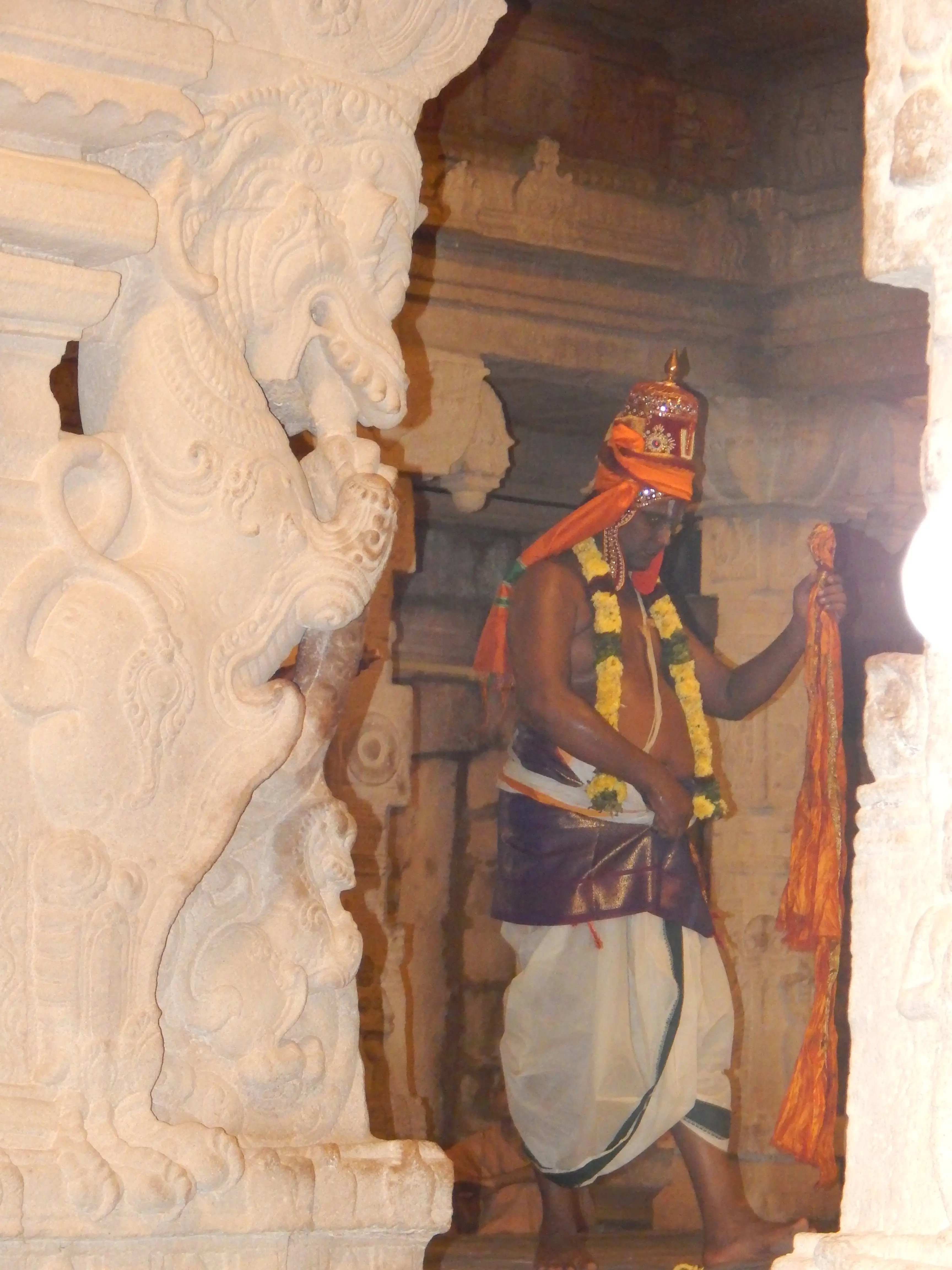
Figure 3
Araiyar Nathamuni of Alvar Tirunagari performs the interpretation for the eleventh verse of the Tiruneṭuntāṇṭakam as part of the Muttukkuṟi, Pakal Pattu Maṇṭapam, Ādi Nātha Perumāḷ Temple, Alvar Tirunagari, Dec. 20, 2015. The orange silk in his left hand signifies both the girl and the silk in which she is draped (paṭṭu uṭukkum ivaḷ). Photograph Archana Venkatesan.So now this, with the translation of anubhava that anchors itself in two places: the girl and her beloved, linked by water. Like the Araiyar, I’ve added the “this girl” (ivaḷ), which during the Muttukkuṟi abhinaya is indicated by pointing to a length of silk that the performer holds up (Fig. 3). And like the Araiyar’s keening mediation on the phrase, paṭṭu-uṭukkum ivaḷ, my translation dwells at length on that phrase:
this girl in silk, this girl, this girl
this girl weak with desire
she wants no dolls
this girl in silk
this girl her long eyes fill with cool tears
this girl her long eyes cool with tears can’t close in sleep
this girl in silk
she refuses to cuddle on my lap for even a moment “where’s my Lord, Lord of all, where’s Tiruvaraṅkam” she asks tell me who’s done this
to my girl with hair so fragrant drunk bees buzz around her
to my innocent fawn
fortune-teller, reveal the truth she replied the One dark as the Ocean
the One dark as the Ocean has done this Who can protect her now?
Who can protect her now?
While the Araiyar’s Muttukkuṟi performance and the commentaries point the way to a rich trove of possible ways to expand the text, to get at its feeling, moving in the opposite direction to contract the text to its base elements can produce equally powerful results. Here the Śrīvaiṣṇava liturgical practice known as muṉṉaṭi-piṉṉaṭi leads the way. Usually used when one is short of time, the recitation is a back and forth, where only the first word or sometimes two lines of text are recited. Here is an example of the muṉṉaṭi-piṉṉaṭi recitation of the Tiruneṭuntāṇṭakam as performed by a single person. Usually, the recitation is done by groups of Brahmin men, who recite the text in a dialogic manner:
In the muṉṉaṭi-piṉṉaṭi recitation of the Tiruneṭuntāṇṭakam, only the first phrase of the first and third line of each of the thirty verses is recited. In the case of the verse in consideration, these two phrases come to be used: paṭṭu uṭukkum ayarttu iraṅkum / maṭṭu vikki maṇi vaṇṭu. Muṉṉaṭi-piṉṉaṭi recitation rests on the assumption that the entire verse, its import, its efficacy, its anubhava resides in these opening phrases; a recitation where words are in a way unmoored from meaning, for there is no way to make grammatical sense of the ways the phrases in a muṉṉaṭi-piṉṉaṭi recitation link together. As a translator, however, I suggest that muṉṉaṭi-piṉṉaṭi offers a counterpoint to the expansion that commentators and Araiyars specialize in. It offers a way to distill a verse to its molecular moments, to where its anubhava resides. Here then, is my āḻvār poem inspired by the brevity of a muṉṉaṭi-piṉṉaṭi recitation. If one were to go with the musical simile that I’ve evoked in the essay’s latter half, muṉṉaṭi-piṉṉaṭi is akin to delineating a rāga simply by touching on its jīva-svaras—the notes that give it life. One simple phrase suffices to bring out the rāga’s’s feel. Muṉṉaṭi-piṉṉaṭi is like that. I choose here to focus on the life-giving notes, the jīva svaras of this verse, where for me its character resides, where its anubhava springs from: em perumāṉ tiruvaraṅkam eṅkē / kaṭal vaṇṇar itu ceytār / kāppār ārē. Here, inspired as much by muṉṉaṭi-piṉṉaṭi recitation as Carnatic music Viruttam singing, I have rearranged the text, opened it, excised it, expanded it, and ultimately take it to a point that is only suggested in the verse:
this girl in silk weak with desire asks
where’s my Lord, Lord of all, where’s his Tiruvaraṅkam?
this girl in silk eyes cool with tears asks
where’s my Lord, Lord of all, where’s his Tiruvaraṅkam? who has done this
Him,
the One dark as the ocean who has done this
Him, the One,
dark as the ocean who can protect her now?
Him, dark as the ocean.
In each of the examples I’ve presented today, the verse has stood singular, a representative, exemplary text ripe with anubhava. There is a long history of such an approach, both within the Tamil literary and commentarial traditions and within the Śrīvaiṣṇava sampradāyas. These interventions, however, do not immediately imply a negation of a work in its entirety, rather it points to a very different conception of a text itself, one marked by fluidity and open, permeable boundaries. Thus, it is common for commentators to quote often and frequently from other āḻvār poets, using their words to illuminate the experience of the poem. This is taken to a kind of terminal limit in Śrīvaiṣṇava commentaries, in which each āḻvār’s composition shines through, refracts, reflects and indeed, exists within every other āḻvār’s poem. Nammāḻvār exists within Tirumaṅkai exists within Kulaśēkara. Such collapsing of textual boundaries and poetic voices is especially evident in Araiyar Cēvai’s various ritual dramas, such as the Muttukkuṟi or the Praṇaya Kalaka Utsavam, where the poems, voices and verses of different āḻvār poets coalesce into one. Although the commentators take great pains to distinguish between various female voices and to particularize female personae as the Parakāla or Parāṅkuśa Nāyikā, they simultaneously enable them to speak through each other. Anubhava here is not mimicry but infinite replication, every āḻvār the voice of another. In such a formulation, the āḻvār text has no boundaries. If one wished to be more cautious, the boundary of the text is permeable and is meant to be breached. In the world of Tamil bhakti, bodies and selves too are equally liquid and open, inviting a heady commingling of god, poet, devotee, and commentator. How can all that emotion ever be contained, confined within such artificial limits? The Tirukkurungudi temple realizes this beautifully during their Adhyayanōtsavam, where Viṣṇu becomes Nammāḻvār, who becomes Tirumaṅkai, and the reciting Brahmins become them too.43 With this in mind, I want to offer one last translation, demonstrating the interpenetration of anubhava that lies at the heart of Śrīvaiṣṇava exegesis.
-
43Tirukkurungudi is one of the 108 divine abodes praised by the āḻvār poets. Located in southern Tamil Nadu, it is famous for the spectacular Aḻakiya Nambi Temple. This site is revered as the place of Tirumaṅkai’s liberation. Local legends assert that Aḻakiya Nambi was born as Nammāḻvār and Nammāḻvār is in turn Tirumaṅkai. These assertions are reflected in several ritual performances across the temple’s annual calendar. For a fuller discussion of the Tirukkurungudi temple, see Branfoot, Orr, Seastrand, and Venkatesan (forthcoming).
In both verses that I chose for this paper, the dominant speaker is the mother, who laments the loss of her daughter. The central conceit is godsickness masquerading as lovesickness, the symptom of which is sleeplessness. Both verses are in praise of Tiruvaraṅkam. Here they are again, in their entirety:
Night or day her eyes won’t close in sleep
Tears pool in the palm of her hands
‘Conch’ ‘Disc’ she cries, pressing her hands together
‘Eyes-lotus’ she cries, growing faint
‘How can I live without you?’ she says
searching this vast earth with her hands.
Lord of Tiruvaraṅkam where red fish dart through the water
What have you done to my girl?Tiruvāymoḻi VII.2.1
she’s wrapped in silk weak with desire, doesn’t want her dolls
her long eyes fill with cool tears she can’t sleep
she refuses to cuddle on my lap for even a moment
“where’s my lord’s Tiruvaraṅkam” she asks
tell me who’s done this
to my girl with hair so fragrant drunk bees buzz around her
to my innocent fawn
fortune-teller, reveal the truth
she replied “the One the color of the Ocean”
Who can protect her now?Tiruneṭuntāṇṭakam 11
If, like a Śrīvaiṣṇava commentator, I heard both poets in both poems (which I must confess, I do); if like a musician who voices a static text, bringing it alive in music, a translation of any one of these verses might look like this:
Night or day her eyes won’t close in sleep
Night or day her eyes can’t close in sleep
Tears pool in the palm of her hands
‘Conch’ ‘Disc’ she cries, pressing her hands together
‘Eyes-lotus’ she cries, growing faint
‘How can I live without you?’ she says
searching this vast earth with her hands.
‘where’s my lord’s Tiruvaraṅkam’ she asks (tiruvaraṅkam eṅkē)
tell me who’s done this, fortune-teller
she replied ‘the One like the Ocean’ (kaṭal vaṇṇar)
tell me who’s done this, fortune-teller
he replied “the Lord of Tiruvaraṅkam” (tiruvaraṅkattāy)
what have you done to my girl? (ivaḷ eṉ ceykiṉrāyē)
Lord of Tiruvaraṅkam (tiruvaraṅkattāy)
Who can protect her now? (kāppār ārē)
Lord of Tiruvaraṅkam (tiruvaraṅkarattāy)
Intimacy, Relish, Kinship: Concluding Thoughts
Almost all translation theory hovers around the irreconcilable tension between sense and sensibility, between the literal and the literary, between meaning and feeling. They wrestle with distance—should one draw the text closer to the reader or the reader closer to the next—a lateral envisioning of our relationship to text, as though we float above it, at some remove. Such an approach simply does not hold for pre-modern and early modern South Asian texts broadly and for the Śrīvaiṣṇava poetic and commentarial traditions specifically. Many of these texts, with their rich performance and manuscript traditions resist the very notion of a stable, singular text that ought to have a single, fixed translated form. This is, I assert, an artificial construct and one that is hard to shake. We translate our multitudes of multivocal pre-modern South Asian texts wedded to a notion of text that is untenable, and from a place of fear, seeking to anchor, nail, fix texts that are inherently plural—whether in their many different manuscript versions, or in the inter-textual reading practices that they invite. This tension emerges because we assume not only the stability of text but also unbridgeable distances between languages, between cultures, and people. Conceived so, translation does not bring us together and instead serves only to affirm how far apart we are. In contrast, a translation of relish, of anubhava, is all about proximity, about cultivating intimacy and closeness, because the act of composition (for the āḻvār) brings one closer to god, the act of commenting (for the commentator) brings one closer to both the āḻvār and god, and it follows that the act of translating draws one into the open circle of āḻvār, god, and commentator. Translation as anubhava grantha approaches the āḻvār poem as permeable and fluid, where the words say what they say, but they say so much more. They talk to other texts within the tradition and beyond them—looking back at the Caṅkam classical poems from which they draw inspiration and looking ahead to the commentaries they inspire and the ritual performances they engender.44 A translation of relish appreciates the āḻvār poem as thickly, densely, embedded within an interlocking, interflowing ecosystem, each component of which is critical to the text’s afterlife. Moreover, it centers the experience of joy, and translation as somatic practice, pushing to the margins the nagging anxiety of loss, the wounding grief of betrayal. Finally, translation as anubhava grantha invites the reader into the text: are there new moments to expand, new places to contract, new ways to split or reorder the text, new interpenetrations to allow? It fosters kinship rather than estrangement.
-
44There is little doubt that the āḻvār poets knew the Tamil Caṅkam corpus well, both in terms of poetic principles and the poems themselves. For example, Nammāḻvār references the concept of the five tiṇais (landscapes) in Tiruviruttam 26 and in this same poem clearly remakes a Caṅkam poem into a bhakti poem—Tiruviruttam 68 parallels Kuṟuntokai 66. Similarly, Kōtai-Āṇṭāḷ remakes another Caṅkam poem, Kuṟuntokai 325 into a bhakti poem in Nācciyār Tirumoḻi 8.1. Tirumaṅkai reinterprets the literary conceit of the maṭal (the unrequited male lover riding a palmyra horse in the town square to win his beloved’s heart), composing two maṭal poems with the bold heroine declaring her intention to undertake the transgressive act to force Viṣṇu’s hand. Nammāḻvār too employs the maṭal in two verses in the Tiruvāymoḻi, V.3.9 and V.3.10.
The approaches and the results I’ve presented here, taking the āḻvār poems as a case-study, are radical, even uncomfortable, and deliberately so. I’ve sought not just to make a case for the value of thinking more expansively about how we approach translating poetry like that produced by the āḻvārs, but to think creatively of ways to engage commentaries and the living worlds of such poetry. I can envisage a translation of anubhava of any pre-modern South Asia poetical verse or poem from which spring multiple streams. If our starting point is that meaning and feeling aren’t opposing forces, but that each resides in the other; if we allow that texts aren’t fragile things that need protection and vigilance from rogue translators; if we accept that translation like commentary exists not only as afterlife of text, a ghost-like impression, an insubstantial, unavoidable, inauspicious specter; if we think of ourselves as musicians, who intervene creatively and joyously within the grammatical confines of the music to illuminate what resides within the text; if we think not in terms of distance, but in terms of intimacy, if we reimagine text as fluid and open, what might our possibilities be?
Notes
-
↑This essay has marinated for a very long time. Over the years, I have presented versions of this paper at several venues. I first presented this paper at the 2016 UW Madison South Asia conference in a panel on translation, alongside exemplary translators, Prof. Steven Hopkins and Prof. Martha Selby. I benefited greatly from their comments at that time as well as from the penetrating questions of our discussant, Prof. E. Annamalai. Subsequently, I presented this essay in longer and shorter forms at Stanford University, the University of Pennsylvania, the University of Texas, Austin, and the University of Toronto. Each of these presentations enriched me and has sharpened my arguments. I am grateful to my interlocutors at these venues. I thank my frequent collaborator, Vidwan Sikkil C. Gurucharan, for generously recording the Tirumaṅkai pācuram that accompanies this essay. I have learned so much from our many conversations about poetry, improvisation, and music, and equally through our collaboration on our joint performance, Lullabies and Laments. Performing alongside Gurucharan enhanced my appreciation of my task as a translator and attuned me to the musicality of the verses. A recording of one of our performances that was the departure point for this essay can be found here. I am also grateful to the late Araiyar Vadapathrasayi of Alvar Tirunagari for everything he taught me in the many years I knew him. I carry with me his explications of the āḻvār poems, and his beautiful performances of Araiyar Cēvai at Alvar Tirunagari are imprinted in my mind. I am glad that his voice lives on in this paper and in the recording of Tirumaṅkai’s verse that he made for me on one of my last visits to his home in Madurai. I also extend my thanks to Malavika Kannan for her careful copy editing of this manuscript and for cleaning up the recording of Araiyar Vadapathrasayi’s recitation. Finally, I thank Andrew Ollett not just for giving this experimental essay a home at NESAR, but for making it look so beautiful. That’s a relish all its own.
-
↑For an example of this style, which adapted the sparse and graphic aesthetic of American modernist poets such as e.e. cummings and William Carlos Williams to the translation of premodern Indic poetry, see Ramanujan 1967, 1973, and 1981.
-
↑See for example, my discussion of my approach to translation see Venkatesan 2013, 2014 and 2020.
-
↑There are many verses in the Tiruvāymoḻi in which Nammāḻvār speaks of being a vessel for Viṣṇu’s words. Here is one example.
Tiruvāymoḻi VII.9.4appaṉai eṉṟu maṟappaṉ eṉ ākiyētapputal iṉṟi taṉaik kavi tāṉ collioppilāt tīviṉaiyēṉai uyyakkoṇṭuceppamē ceytu tirikinṟa cīrkaṇṭēCan I ever forget my father? He’s become meVenkatesan 2020, 241
sings perfect songs about himself. I am incomparable
in my wickedness, yet he lifts me up
makes me better. I’ve seen his brilliance. -
↑Translations are an unusual literary art, for the translator produces them with the knowledge that they will be replaced by a fresher or different translation. Translation foregrounds renewal, both of the source-work and of the translator’s craft itself. Examples abound of translations that have fallen out of fashion or canonical works that invite multiple translations. For the latter case, see for instance, Seamus Heaney’s masterful translation of Beowulf (2001) and Maria Headley’s radical translation of the same text (2020). To my point about Chapman’s translation of Homer (published between 1598–1616), which the English poet John Keats (1795–1821) read, and in response produced his first great sonnet, “On First Reading Chapman’s Homer” (October 1816): The sonnet is as much about the poet’s encounter with Homer mediated through Chapman as it is a meditation about translation’s transformative power. But Chapman’s Homer, which Keats preferred to Alexander Pope’s famous translation of both the Iliad and Odyssey (published between 1715–1726), was soon replaced by several other attempts, including Richmond Lattimore’s 1965 translation. For a discussion of these translations and Keats’s encounter with Chapman, see Power 2021. More recently, Emily Wilson’s translation of Homer’s Odyssey (2017) has offered a new, much lauded intervention.
-
↑Consider that commentaries, like translation, are also renewed and expanded. As with translation, commentaries affirm the canonicity of the source-text; they too are about ensuring the text’s afterlife.
-
↑This encounter occurred during fieldwork on December 20, 2015, at the Ādi Nātha temple, Alvar Tirunagari. Mārkaḻi falls between mid-December and mid-January.
-
↑The Araiyar (reciter) is a male, brahmin Śrīvaiṣṇava hereditary ritual specialist. Their special service (Cēvai) combines recitation and gestural interpretation. The full Araiyar Cēvai survives in three temples in Tamil Nadu: Srirangam, Srivilliputtur, and Alvar Tirunagari. It survives in an abbreviated form at the temple in Melkote. The Araiyars trace their lineage to Nāthamuni (c. tenth century), who is the Śrīvaiṣṇava traditions’ first preceptor. According to Śrīvaiṣṇava oral histories and written hagiographies, Nāthamuni was responsible for compiling and canonizing the Śrīvaiṣṇava Tamil canon, the Nālāyira Divya Prabandham. For a comprehensive discussion of the dating and narratives relating to Nāthamuni and the formation of the Nālāyira Divya Prabandham see Young 2024.
While the Adhyayanōtsavam is celebrated in many Śrīvaiṣṇava temples, only the temples of Srirangam, Srivilliputtur, and Alvar Tirunagari integrate Araiyar Cēvai into the ritual events.
The Adhyayanōtsavam is divided into two halves. The first half, called Pakal Pattu (Morning Ten) is devoted to the recitation of the first two books of the Nālāyira Divya Prabandham, concluding with the liberation (mōkṣa) of Tirumaṅkai Āḻvār. The second half of the festival, called Irā Pattu, begins on Vaikuṇṭha Ēkādaśī and is focused on the recitation of Nammāḻvār’s Tiruvāymoḻi. The Iyaṟpā section of the Divya Prabandham is also recited during this time, generally during processions. Irā Pattu concludes with Nammāḻvār’s mōkṣa.
-
↑The Muttukkuṟi also utilizes verses from the Fourth Decad of Kōtai-Āṇṭāḷ’s Nācciyār Tirumoḻi for the actual divination. Such stitching together of the voices of āḻvār poets is typical in commentary and in Araiyar Cēvai performance. It presents a view of the āḻvār text (and by extension, the āḻvār) as inter-penetrating, interlocking, and inter-mirroring. That is, the experiences of the poets are not seen as singular or bounded, but one that is permeable and that permeates the poems, which are the records of the experience. For a discussion of the Muttukkuṟi drama at the Āṇṭāḷ temple in Srivilliputtur see Venkatesan 2005.
The tāṇṭakam is a meter. Tirumaṅkai composed two poems in this meter. The short, 20-verse Tirukkuṟuntāṇṭakam (Shorter Tāṇṭakam) and the longer, 30-verse Tiruneṭuntāṇṭakam. For a discussion of the tāṇṭakam meter and Tirumaṅkai’s use of it, see Ate 2019, 12–23.
-
↑The rahasya-traya are three foundational mantras, articulations of faith by Śrīvaiṣṇavas. They affirm the supremacy of Viṣṇu, of the inseparability of Viṣṇu and his consort, and assert that Viṣṇu is the devotee’s sole refuge in the quest for liberation, mōkṣa. They are the mūla/tiru mantra, the dvayam, and the carama ślōka. The mūla/tirumantra: ōṁ namō nārāyaṇāya, “Obeisance to Nārāyaṇa.” The dvayam is: śrīman nārāyaṇāya caraṇau śaraṇaṁ prapadyē/śrīmatē nārāyaṇāya namaḥ (I take refuge at the feet of Śrī and Nārāyaṇa/Obeisance to Śrī and Nārāyaṇa) and the carama ślōka (Bhagavad Gītā 18.66): sarvadharmān parityajya mām ēkaṁ śaraṇam vraja/aham tvā sarvapāpēbhyō mōkṣayiṣyāmi mā śucaḥ (Abandoning all other paths, take refuge with me/I will make you free from all sins. Do not despair.).
“By the first ten [verses of the Tiruneṭuntāṇṭakam], the meaning of the tirumantra is made clear; by the second ten [verses], the meaning of the carama ślōka; by the first ten verses, bhakti is described. By the second ten, prapatti, and by the third ten, the [importance of] mediation (puruṣakāra) is proclaimed.” Translation by Narayanan 1987, 140.
This interpretation is repeated in oral interpretations of the text, as it was to me by Araiyar Vadapathrasayi of Alvar Tirunagari during one of our many conversations. This reading is confined to the poem’s opening ten verses.
The five forms of Viṣṇu are paratva (transcendent), vyūha (emanations), vibhava (avatāra), arcā (icon), antaryāmin (in-dwelling).
Periyavāccāṉ Piḷḷai was the first Śrīvaiṣṇava author to compose individual commentaries on every composition in the Nālāyira Divya Prabandham. This earns him the title, vyākhyāna-cakravartī, king of commentators.
-
↑There is a substantial body of scholarship on the Śrīvaiṣṇava concept of prapatti. Two important recent interventions are Raman 2007 and Akepiyapornchai 2026. For an overview of the development of the Śrīvaiṣṇava traditions, including a discussion of how different important teachers within those traditions approached prapatti, see Narayanan 1987. For a discussion of Rāmānuja’s philosophy see Lipner 1986.
-
↑The phrase used to describe Tirumaṅkai’s attainment is mayaṟvaṟa mati nalam (the virtuous/good mind that cuts through delusion), which occurs in the opening verse of the Tiruvāymoḻi.
-
↑For instance, here is an excerpt from the commentary on the eleventh verse of the Tiruneṭuntāṇṭakam by the celebrated twentieth-century century Śrīvaiṣṇava commentator, Uttamur Veeraraghavachariar, in which he invokes anubhava. He writes about anubhava in the context of discussing the introduction of the female voice, which occurs in the poem’s eleventh verse: ippaṭi strīyāṉvārkaliṉ pācuraṅkaḷai yaṉupavippavar inta nilaiyai uṇarntu cuvattaltakum ... nām avarkaḷiṉ coṟkaḷai yaṉpavikkum pōtu takkavāṟu nāyakiyiṉ nilaikaḷ pala aṟintu koḷvatām “The ones who enjoy (aṉupavippavar) the verse of those who have become women feel and taste this state. When we enjoy their words, we apprehend the heroine’s state” (Vīrarākavācāriyaṉ 1993, 55–56).
-
↑For a discussion of the dual architecture of the Tiruviruttam see Venkatesan 2014, 142–156. For a discussion of female voices in the Tiruviruttam, see Venkatesan 2014, 124–133. For a fuller discussion of the female voices in the Tiruvāymoḻi see Venkatesan 2020, 20–27. For a discussion of female voices and Tamil Vaiṣṇava bhakti, see Hardy 1983.
-
↑For example, see this beautiful verse from the end of the Tiruvāymoḻi:
Tiruvāymoḻi X.7.2tāṉē āki niṟantu ellāulakum uyirum tāṉē āytāṉē yāṉ eṉpāṉ ākittaṉṉait tāṉē tutittu eṉakkuttēṉē pālē kaṉṉalē amutē tirumāliruñcōlaikkōṉē āki niṉṟoḻintāneṉṉai muṟṟum uyir uṇṭēHe filled me with himself, filled everythingVenkatesan 2020, 320
every world every life. He became me,
called himself me to sing of himself.
The king of Tirumāliruñcōlai, sweet
as honey milk sugar nectar
has devoured me entirely. -
↑As the Heroine's friend: Tiruvāymoḻi IV.6, VI.5 and VIII.9; as the Heroine's mother: Tiruvāymoḻi II.4, IV.2, IV.4, V.6, VI.6, VI.7, and VII.2; as the Heroine herself: Tiruvāymoḻi I.4, II.1, IV.8, V.3, V.4, V.5, V.9, VI.1, VI.2, VI.8, VII.3, VII.7, VIII.2, IX.5, IX.7, IX.9, X.3. The last two decads—IX.9 and X.3—are in the voice(s) of the gōpīs. These are the only two decads in which Nammāḻvār particularizes the voice. In the other heroine-voiced verses, she is anonymous and generic.
-
↑Classical Tamil poetry (first to third century CE) was divided into two large, complementary categories. One category was akam, which explored the private sphere, specifically love. Here, the characters in the poem were anonymous stock characters—the hero, the heroine, the mother, the friend, and so forth. The second category was puṟam, which explored the public sphere, and thus concerned kings, poets, war, and ethics. Here, poets named themselves and their patrons. Tamil bhakti poetry draws from both akam and puṟam, inaugurating a new genre. For a discussion of the transformation of classical Tamil poetics into the poetics of bhakti, see Cutler 1987 and Cutler and Ramanujan 1999. For a translation of classical Tamil love poems, see Ramanujan 1967 and Selby 2000 and 2011. For a discussion of the transformation of classical Tamil poetics to Tamil bhakti poetics, see Cutler 1987 and Cutler and Ramanujan 1999.
-
↑Several of the āḻvār poets use the female voice. This female voice maybe generic and anonymous voice, particular and identifiable, or particular but anonymous. For example, Viṣṇucittaṉ-Periyāḻvār uses a particular and identifiable female voice (Yaśodā) as does Kulaśēkhara (Devakī, Kausalyā). Kulaśēkhara and Kōtai-Āṇṭāl use a particular but anonymous voice, the gōpī. Several of the āḻvār poets use a generic, anonymous female voice, which in the commentaries comes to be identified with the poet themselves. For a discussion of the particularity of female voices, see Venkatesan forthcoming and Kannan 2026.
-
↑For a detailed discussion of this dual architecture as it pertains to a single work, see Venkatesan 2014, 142–156.
-
↑Damodaran 1976, 70–77.
-
↑Damodaran 1976, 64–65.
-
Tiruviruttam 1poyniṉṟa ñāṉamum pollā oḻukkum aḻukku uṭampumin niṉṟa nīrmai iṉi yām uṟavāmai uyir aḷippāṉen niṉṟa yōṉiyumāyp piṟantāy imaiyōr talaivāmeyn niṉṟu keṭṭarulāy aṭiyēṉ ceyyum viṇṇappamēFalse wisdom wicked conduct dirty bodiesVenkatesan 2014, 25
Let’s not draw near such things now
To protect life
you took birth from many wombs
O master of the unblinking one
stand before me embodied
listen graciously to a servant’s plea. -
↑For an excellent discussion of allegoresis and Śrīvaiṣṇava commentary, albeit in relation to the Vālmīki Rāmāyaṇa, see Rao 2015.
-
↑This is a new translation of the verse for the purposes of the paper. I have left out the colophon identifying the speaker, which is borrowed into the translation from the commentary. The published translation creatively uses spacing and indenting to reveal the poem’s structure. See Venkatesan 2014 for a complete translation of the Tiruviruttam.
-
↑Tiruviruttam, pp. 29–38.
-
↑There are several commentaries on the Tiruvāymoḻi. Here, I am relying on the commentary called the Īṭu. The text’s rich and continuous commentarial history stands in stark contrast to the paucity of available translations of the Tiruvāymoḻi. The earliest commentary was written by Tirukkurukai Pirāṉ Piḷḷāṉ (eleventh to early twelfth century) at the behest of Rāmānuja (1017–1137). This is referred to as the Ārāyirappaṭi (6000). This is followed by Nañjīyar’s 9000 (twelfth century), his student Nampiḷḷai’s magnum opus 36,000 paṭi composed also known simply as the Īṭu, and the 24,000 paṭi commentary by Vyākhyāna Cakravarti, Periyavāccāṉ Piḷḷai, who was Nampiḷḷai’s student. In addition to these classical commentaries, which were largely composed between the eleventh and fourteenth centuries, there are innumerable twentieth-century exegeses of the text, with two towering figures representing them: Uttamur Viraraghavachariar, whose interpretations represent the Vaṭakalai or northern branch of the Śrīvaiṣṇava Sampradāya, and Anangachariar Svami of the Teṅkalai school. Vēdānta Dēśika (1268–1369) composed a Sanskrit commentary/summary of the Tiruvāymoḻi called the Drāmiḍōpaniṣad Tātparya Ratnāvalī (The Garland of Gems of Reality in the Tamil Upaniṣad). Apart from Dēśika’s important work, all the classical commentaries on the Tiruvāymoḻi are composed in Maṇipravāḷa, a stylized hybrid language that combines Sanskrit vocabulary with Tamil grammar. As several scholars have pointed out, the choice to author commentaries in Maṇipravāḷa rather than Tamil or Sanskrit is itself a statement of Śrīvaiṣṇavism’s self-representation as Ubhaya Vēdānta (Dual Vēdānta). It is also worth noting that the classical commentaries predate the sectarian split of the Śrīvaiṣṇava Sampradāya into the Vaṭakalai and Teṅkalai schools. In addition to these commentaries, we have an additional work, the Ācārya Hr̥dayam, authored by the thirteenth century teacher, Aḻakiya Maṇavāḷa Perumāḷ Nāyaṉār (see below). For a thorough discussion of Piḷḷāṉ’s commentary, see Carman and Narayanan 1989.
-
↑The Śrīvaiṣṇava commentators often resort to invoking the Vālmīki Rāmāyaṇa in their commentaries. In this epic poem, the hero, Prince Rāma, is exiled to the forest for a period of twelve years. He is accompanied by his chaste wife, Sītā, and his devoted younger brother, Lakṣmaṇa. Towards the end of their exile, Sītā is abducted by the demon-king, Rāvāṇa, and imprisoned in his fortressed-island city of Laṅkā. Rāma wages a war against Rāvaṇa, killing him in battle, and rescuing his wife. He returns home with his wife and brother, and is crowned king, ushering a utopic period of peace and abundance. Rāma is an avatāra of Viṣṇu and Sītā is the goddess, Lakṣmī. In the commentarial readings, Sītā is the soul/self, yearning for union with god (Rāma). For a fulsome discussion of the use of the Rāmāyaṇa in Śrīvaiṣṇava commentary, see Narayanan 1994a.
-
↑This unfolds on the seventeenth night of the Adhyayanōtsavam and the seventh night of the Irā Pattu Utsavam/Tiruvāymoḻi Utsavam.
-
↑Composed by Aḻakiyamaṇavāḷa Perumāḷ Nāyaṉār, a scion of the famous Vaṭakkuttiruvīti Piḷḷai, author of the authoritative Īṭu commentary on the Tiruvāymoḻi, the Ācārya Hr̥dayam offers a succinct contemplation of Nammāḻvār’s poetry and its philosophy in 234 sūtras (referred to as cūrṇikai).
-
↑Ācārya Hr̥dayam, pp. 93–95.
-
↑Here are two exemplary verses from these two decads that support the commentators’ indexing of the āḻvār’s voice in terms of union and separation. In VI.10, he is experiencing union/or union is imminent and thus speaks in his own voice:
Tiruvāymoḻi VI.10.9vantāy pōlē vārātāy vārātāy pōl varuvāṉēcentāmaraik kaṇ ceṅkaṉi vāy nāltōḷ amutē eṉatu uyirēcintāmaṇikaḷ pakar allaip pakal cey tiruvēṅkaṭatāṉēantō aṭiyēṉ uṉ pātam akalilēṉ iṟaiyumēYou seem to come, then don’tVenkatesan 2020, 215
you seem not to come, yet here you are,
eyes bright as lotus lips red as fruit
four great shoulders, sweet nectar
my precious life, master of Tiruvēṅkaṭam
where brilliant gems turn night into day
I can’t be apart from your feet for an instant.In contrast, VII.2 is decidedly from the vantage of separation. The āḻvār is separated from Viṣṇu and hence speaks in his female guise. But there is a double separation, as the girl’s mother too is separated from her daughter, who has given herself over to Viṣṇu:
Tiruvāymoḻi VII.2.5cintikkum ticaikkum tēṟum kai kūppum tiruvaraṅkattuḷḷāy eṉṉumvantikkum āṅkē maḻaikkaṇ nīr malka vantiṭāy eṉṟu eṉṟē mayaṅkumantippōtu avuṇaṉ uṭal iṭantāṉē alai kaṭal kaṭanta ār amutēcantittu uṉ caraṇam cārvaṭe valitta taiyalai maiyal ceytāṉēShe’s lost in thought, faints,Venkatesan 2020, 223
recovers, cups her hands muttering,
‘You’re in Tiruvaraṅkam.’ Come here
she calls as her eyes rain tears.
As dusk fell you ripped apart the demon
precious nectar who churned the ocean
You’ve bewitched this girl now wasting away
She only desires to be at your feet. -
↑Ācārya Hr̥dayam, pp. 93–95.
-
↑Bhagavat Viṣayam, vol. 7, pp. 50–56.
-
↑Bhagavat Viṣayam, vol. 7, pp. 56–61.
-
↑For a discussion of the art of the Śrīvaiṣṇava commentator, see Clooney 1996. For a thoughtful analysis of the commentaries on two girl-voiced decads in the Tiruvāymoḻi, see Clooney 1991 and 1988.
-
↑I propose that Śrīvaiṣṇava commentaries function like translation and a translation as relish, as anubhava, is a commentary. Thus, both the commentary and the translation ensure the afterlife of the text. See Benjamin 2021.
-
↑This is a reference to the line from Tirumaṅkai’s Periya Tirumoḻi. In incorporating this line, I am reproducing a key technique of the commentaries, in which one āḻvār’s words can telescope into another’s.
-
↑The Tiruvāymoḻi commentaries do not reference the Periya Tirumoḻi in this exegesis of this verse. This is my own intervention, my relish, my anubhava.
-
↑This translation also centers the girl’s experience and focuses on her sleeplessness. It follows the commentaries lead in making this choice. As the second peer reviewer of this essay astutely pointed out, the verse is uttered by the mother and is as much about her grief (perhaps even more so) than the girl. Further, as Reviewer 2 also suggests, we might read the loaded word aṟiyāḷ (unaware, not knowing) as one that is about insensibility and madness. That is, the girl is not choosing sleeplessness. She is incapable of knowing what sleep even is. I can well imagine a gorgeous interpretation/translation of this verse that pairs the girl’s mad insomnia and her mother’s helpless terror at witnessing it. This would produce an altogether differently textured reading but would equally open even more possibilities for the poem. Reviewer 2’s detailed renditions of this pācuram in their comments on this paper are, I would argue, their anubhava of this evocative verse.
-
↑See, for instance, A.K. Ramanujan’s discussion of concentric containments in his “Is There An Indian Way of Thinking?” which is framed in terms of context sensitive reading ( 1999, 44). Following McGann, he discusses this radial reading practice in his essay, “Where Mirrors are Windows,” in relation to his discussion of poems that participate in a “large self-reflexive paradigm” (1989).
-
↑For a thorough discussion of Ōtuvār-style viruttam singing of the Tēvāram poems and the ways in which it reflects Tamil Śaiva understandings of text, see Peterson 1991, 67–75.
-
↑Tirukkurungudi is one of the 108 divine abodes praised by the āḻvār poets. Located in southern Tamil Nadu, it is famous for the spectacular Aḻakiya Nambi Temple. This site is revered as the place of Tirumaṅkai’s liberation. Local legends assert that Aḻakiya Nambi was born as Nammāḻvār and Nammāḻvār is in turn Tirumaṅkai. These assertions are reflected in several ritual performances across the temple’s annual calendar. For a fuller discussion of the Tirukkurungudi temple, see Branfoot, Orr, Seastrand, and Venkatesan (forthcoming).
-
↑There is little doubt that the āḻvār poets knew the Tamil Caṅkam corpus well, both in terms of poetic principles and the poems themselves. For example, Nammāḻvār references the concept of the five tiṇais (landscapes) in Tiruviruttam 26 and in this same poem clearly remakes a Caṅkam poem into a bhakti poem—Tiruviruttam 68 parallels Kuṟuntokai 66. Similarly, Kōtai-Āṇṭāḷ remakes another Caṅkam poem, Kuṟuntokai 325 into a bhakti poem in Nācciyār Tirumoḻi 8.1. Tirumaṅkai reinterprets the literary conceit of the maṭal (the unrequited male lover riding a palmyra horse in the town square to win his beloved’s heart), composing two maṭal poems with the bold heroine declaring her intention to undertake the transgressive act to force Viṣṇu’s hand. Nammāḻvār too employs the maṭal in two verses in the Tiruvāymoḻi, V.3.9 and V.3.10.
Primary Sources
- Aṉṉapukaḻ Muṭumpai Aḻakiya Maṇavāḷap Perumāḷ Nāyaṉār Aruḷicceyta Ācārya Hr̥dayam. 1950. Madras: Madras Rattiṉam Press.
- Gopālakiruṣṇamācāriyār, Vai. Mu., and A. Vi. Narasimmācāriyār, eds. 1924–1930. Bhagavat Viṣayam. 10 vols. Kiruṣṇamācāriyar Publishers.
- Guruparamparaprābhavam 3000. 1913. Tiruvallikkēṉi: Sri Vanibhusanam Publishers.
- Aṇṇaṅkarācārya, P. B., ed. 1972. Nālayira Divya Prabandham. Kanci: Aṇṇaṅkarācārya Institute.
- Iyengar, Krishnaswami, ed. n.d. Nālayira Divya Prabandham. Trichy: Srinivasa Press.
- Naidu, Purushottam, B. R. 1973. Tiruvāymoḻi Īṭṭiṉ Tamiḻākkam. 2nd ed. 10 vols. Madras: University of Madras Press.
- Periyavāccaṉ Piḷḷai. 1994. Tiruviruttam Vyākhyāṉam. Kodambakkam, Chennai: Sri Vaishava Sri.
- Piṉpaḻakiyaperumāḷ Cīyar. 1927. Guruparamparaprabhāvam 6000. Tiruvallikkēṇi: Nōpil Accakkūṭam.
- Varadarajan, M. 2009–2012. Tiruvāymoḻi Paṉṉīrāyirappaṭi Uraiyum Tamiḻākkamum. 10 vols. Chennai: Bhakatamrutam Sri Ananth Publications.
- Venkatesan, Archana, and Sikkil C. Gurucharan. 2020. “Lullabies and Laments: Experiments in Translation.” Sant Jordi Festival, New York City, July 8. https://www.youtube.com/watch?v=y0ePWf-3N84.
Secondary Sources
- Akepiyapornchai, Manasicha. 2026. Surrender to God Across Languages: Multilingual Intellectual History of Premodern
India. New York: Oxford University Press.
 10.1093/9780197840573.001.0001.
 - Ate, Lynn. 2019. Tirumaṅkai Āḻvār’s Five Shorter Works: Experiments in Literature. Collection Indologie 140. Pondicherry: Institut français de Pondichéry and École française d’Extrême-Orient.
- Benjamin, Walter. 2021. “The Task of the Translator.” Translated by Harry Zohn. In The Translation Studies Reader, edited by Lawrence Venuti, 89–97. New York: Routledge. 4th edition.
- Branfoot, Crispin, Leslie Orr, Anna Seastrand, and Archana Venkatesan. Forthcoming. Temple of the Heart: Imagining a Home for Viṣṇu at Tirukkurungudi. Heidelberg: HEIP.
- Carman, John and Vasudha Narayanan. 1989. The Tamil Veda: Piḷḷāṉ’s Interpretation of the Tiruvāymoḻi. Chicago and London: University of Chicago Press.
- Clooney, Francis X. 1988. “‘I Created Land and Sea’: A Tamil Case of God-Consciousness
and Its Śrīvaiṣṇava Interpretation.” Numen 35.2: 238–259. 10.2307/3269973.
- Clooney, Francis X. 1991. “Nammāḻvār's Glorious Tiruvallavāḻ: An Exploration in the
Methods and Goals of Śrīvaiṣṇava Commentary.” Journal of the American Oriental Society 111.2: 260–276. 10.2307/604018.
- Clooney, Francis X. 1994. The Art and Theology of Śrīvaiṣṇava Thinkers: The De Nobili Endowment Lectures. Madras: Satya Nilayam Research Institute.
- Clooney, Francis X. 1996. Seeing Through Texts: Doing Theology Among the Śrīvaiṣṇavas of South India. Albany: State University of New York.
- Cutler, Norman. 1987. Songs of Experience: The Poetics of Tamil Devotion. Religion in Asia and Africa. Bloomington and Indianapolis: Indiana University Press.
- Cutler, Norman and A. K. Ramanujan. 1999. “From Classicism to Bhakti.” In The Collected Essays of A. K. Ramanujan, edited by Vinay Dharwadker, 232–259. New Delhi: Oxford University Press.
- Damodaran, G. 1976. Ācārya Hṛdayam: A Critical Study. Tirupati: Tirumalai Tirupati Devasthanams.
- Damodaran, G. 1978. The Literary Value of Tiruvāymoḻi. Tirupati: Sri Venkateswara University.
- Hardy, Friedhelm. 1983. Viraha-Bhakti: The Early History of Kṛṣṇa Devotion in South India. New Delhi: Oxford University Press.
- Hart, George L. 1979. Poets of the Tamil Anthologies: Ancient Poems of Love and War. Princeton: Princeton University Press.
- Hart, George L. 1988. The Poems of Ancient Tamil: Their Milieu and Their Sanskrit Counterparts. Berkeley: University of California Press.
- Kannan, Malavika. Forthcoming. “A Lament without Memory: To Feel as Kulacēkaraṉ’s Devakī – The Othered Mother.” Journal of Vaishnava Studies 34.2.
- Lipner, Julius. 1986. The Face of Truth: A Study of Meaning and Metaphysics in the Vedantic Theology of Rāmānuja. Albany, NY: State University of New York Press.
- Narayanan, Vasudha. 1987. The Way and the Goal: Expressions of Devotion in the Early Śrī Vaiṣṇava Tradition. Washington, D. C.: Institute for Vaishnava Studies and Center for the Study of World Religions, Harvard University.
- Narayanan, Vasudha. 1992. “Oral and Written Commentary on the Tiruvāymoḻi.” In Texts in Context: Traditional Hermeneutics in South Asia, edited by Jeffrey Richard Timm, 85–107. Albany: State University of New York Press.
- Narayanan, Vasudha. 1994a. “The Rāmāyaṇa in the Theology and Experience of the Śrīvaiṣṇava Community.” Journal of Vaishnava Studies 2.4: 55–89.
- Narayanan, Vasudha. 1994b. The Vernacular Veda: Revelation, Recitation and Ritual. Columbia: University of South Carolina Press.
- Narayanan, Vasudha. 1995. “The Realm of Play and the Sacred Stage.” In Gods at Play: Līlā in South Asia, edited by William Sturman Sax, 177–204. New York: Oxford University Press.
- Peterson, Indira Viswanathan. 1991. Poems to Śiva: The Hymns of the Tamil Saints. Delhi: Motilal Banarasidass Publishers.
- Power, Henry. 2021. “Homer and the Discovery of the Pacific: Gunn, Keats, Pope.” The Review of English Studies 72.304: 355–371. 10.1093/res/hgaa103.
- Raman, Srilata. 2007. Self-surrender (Prapatti) to God in Śrīvaiṣṇavism: Tamil Cats and Sanskrit Monkeys. London: Routledge.
- Ramanujan, A. K. 1967. The Interior Landscape: Love Poems from a Classical Tamil Anthology. Bloomington: Indiana University Press.
- Ramanujan, A. K. 1973. Speaking of Śiva. Delhi: Penguin Classics.
- Ramanujan, A. K. 1981. Hymns for the Drowning: Poems for Viṣṇu by Nammāḻvār. Delhi: Penguin Classics.
- Ramanujan, A. K. 1989. “Where Mirrors are Windows: Towards an Anthology of Reflections.” History of Religions 28.3: 187–216.
- Ramanujan, A. K. 1999. “Is There an Indian Way of Thinking?” In The Collected Essays of A. K. Ramanujan, edited by Vinay Dharwadker, 34–51. New Delhi: Oxford University Press.
- Rao, Ajay. 2015. Re-figuring the Rāmāyaṇa as Theology: A History of Reception in Premodern India. London and New York: Routledge. 10.4324/9780203521496.
- Selby, Martha. 2000. Grow Long, Blessed Night: Love Poems from Classical India. New York: Oxford University Press. 10.1093/oso/9780195127331.001.0001.
- Selby, Martha Ann. 2008. “Dialogues of Space, Desires, and Gender in Tamil Caṅkam Poetry.” In Tamil Geographies: Cultural Constructions of Space and Place in South India, , edited by Martha Ann Selby and Indira Viswanathan Peterson, 17–42. Albany: State University of New York Press.
- Selby, Martha Ann. 2011. Tamil Love Poetry: The Five Hundred Short Poems of the Aiṅkuṟunūṟu. New York: Columbia University Press. 10.7312/selb15064.
- Venkatesan, Archana. 2005. “Divining the Future of a Goddess: The Araiyar Cēvai as commentary at the Śrīvilliputtūr Āṇṭāḷ Temple.” Nidān: The International Journal of Hinduism 17: 19–51.
- Venkatesan, Archana. 2010. The Secret Garland: Āṇṭāḷ’s Tiruppāvai and Nācciyār Tirumoḻi. New York: Oxford University Press.
- Venkatesan, Archana. 2013. “Crossing the Wastelands: The Poetry and Commentary of the Tamil Vaishnavas.” Governors’ Report of the Oxford Center for Hindu Studies, August 2013, pp. 16–18.
- Venkatesan, Archana. 2014. A Hundred Measures of Time: Tiruviruttam. Delhi: Penguin Classics.
- Venkatesan, Archana. 2020. Endless Song: Tiruvāymoḻi. Delhi: Penguin Classics.
- Venkatesan, Archana. Forthcoming. “Devotional Polyphony: Voice in Tamil Bhakti Poetry.” In The Cambridge History of Indian Literature, edited by Francesca Orsini and Whitney Cox. Cambridge: Cambridge University Press.
- Vīrarākavācāriyaṉ, Uttamūr. 1993. Upaya Vētānta Kirantamālai. Tirumaṅkaiyāḻvār Aruḷicceyta Tirukkuṟuntāṇṭakam Tiruneṭuntāṇṭakam Tiruveḻukūṟṟirukkai Ciṟiya Tirumaṭal Periya Tirumaṭal. Mylapore: The Visistadvaita Pracharini Sabha.
- Wilden, Eva. 2014. “Nammāḻvār as a Master of Tiṇaimayakkam—Transposition Technique in the Akam Songs of the Tiruvāymoḻi.” In Mapping the Chronology of Bhakti: Milestones, Stepping Stones, and Stumbling Stones; Proceedings of a Workshop Held in Honour of Paṇḍit R. Varadadesikan, edited by Valérie Gillet, 317–333. Pondicherry: French Institute of Pondicherry and École Française d’Extrême-Orient.
- Young, Katherine. 2024. The Tamil Veda and Tangled Tales: A New Approach to Śrivaiṣṇava History. Collection Indologie 160. Pondicherry: Institut français de Pondichéry.
Revision history
- 2026-09-24 [proof] (ollett): Second proof generated
- 2026-04-10 [proof] (ollett): First proof generated